
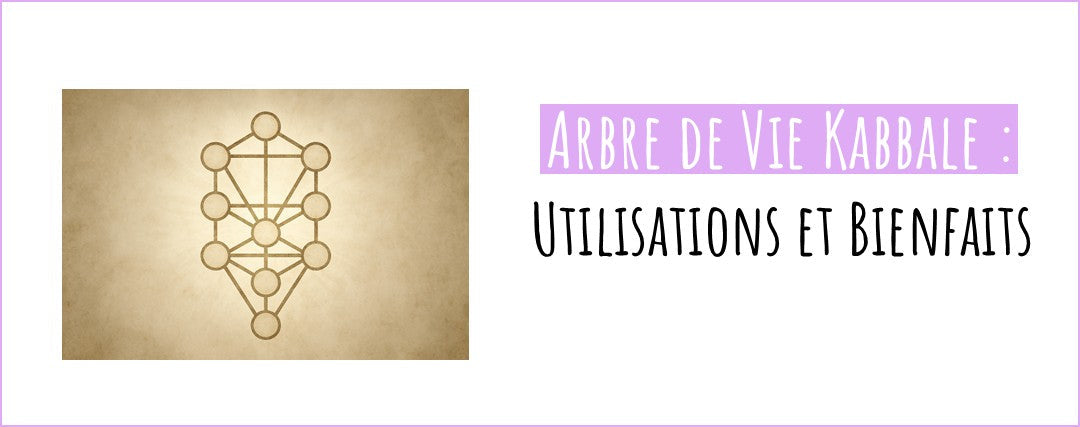
Tree of Life Kabbalah and Spirituality: Uses and Benefits
The Kabbalistic tree of life, also called the tree of life of the Kabbalah or the tree of the Sephiroth, is one of the most fascinating and mysterious symbols of the Jewish esoteric tradition. For centuries, it has inspired researchers, mystics, and artists through its complex structure and universal scope. Whether you are passionate about Hebrew Kabbalah, a fan of spirituality, or simply curious to discover this ancient sacred scheme, the Kabbalistic tree of life offers you a gateway to a deeper understanding of the universe and yourself. Its graphic representation, composed of the ten Sephiroth connected by twenty-two paths, is much more than a simple diagram: it embodies the subtle dynamic between matter and spirit, the finite and the infinite, the human and the divine.
In this article, you will discover the history of the Sephirotic tree, its hidden meanings, its spiritual uses, and the benefits it can bring to your personal journey. We will also address the differences between the Kabbalistic tree of life and the universal tree of life, to better understand why this symbol continues to captivate so many people around the world.
Origins and History of the Tree of Life in Kabbalah
Birth and evolution in Hebrew mysticism
The Kabbalistic tree of life finds its source in the Jewish mystical tradition known as Kabbalah. This esoteric movement developed gradually from the 12th century onwards, particularly in Spain and Provence. The Kabbalah is not a single book but a collection of oral and written teachings, among which the Zohar and the Sefer Yetzirah hold a central place. The tree of life of the Kabbalah established itself as a schematic representation of the divine energies that structure all of Creation. Each Sephirah (plural Sephiroth) symbolizes a facet of divine emanation and a stage in the process by which the Infinite materializes in the finite world.
From its appearance, the tree of the Sephiroth fascinated scholars and initiates. It is perceived as a blueprint of the universe and, at the same time, a map of the human soul. Each element corresponds to a spiritual quality and a level of consciousness that the practitioner can explore and harmonize. During the Renaissance, the Sephirotic tree was integrated by Christian philosophers and alchemists who saw in it a universal key to linking traditions.

Influences and diffusion in Western esotericism
Over the centuries, the Sephiroth tree scheme has traveled beyond Kabbalistic circles. Hermetic thinkers and occultists interpreted this tree as a system of correspondences linking planets, elements, Hebrew letters, and Tarot cards. In the 19th century, the English esoteric society of the Hermetic Order of the Golden Dawn played a major role in the spread of Kabbalistic concepts in the West. It was during this time that the Kabbalistic tree of life became a tool for study and meditation favored by many adepts of occultism and comparative symbolism.
The popularity of the Kabbalistic tree of life has continued to grow with the development of New Age movements and contemporary interest in ancient wisdom. Today, it is found represented on jewelry, illustrations, spiritual books, and even decorative objects. This diffusion has sometimes simplified or reinterpreted the original notions, but it bears witness to a still-living enthusiasm. The tree of the Sephiroth continues to inspire those who seek a unified vision of the material and spiritual worlds.
The Structure of the Tree of the Sephiroth
The 10 Sephiroth: pillars of spiritual architecture
The tree of life of the Kabbalah is made up of ten main emanations called Sephiroth. These spheres represent the fundamental aspects of Creation, energies that are both cosmic and psychic. Each has a name, a meaning, a symbol, and a divine attribute. Here is an overview of these ten Sephiroth, which form the backbone of the Sephirotic tree:
- Keter – The Crown: pure potentiality and the origin of all emanation.
- Chokhmah – Wisdom: the primary creative impulse.
- Binah – Intelligence: the capacity to structure and give form.
- Chesed – Mercy: expansive and unconditional love.
- Gevurah – Rigor: the force that limits and disciplines.
- Tiphereth – Beauty: the harmony that connects opposing forces.
- Netzach – Victory: endurance, creative perseverance.
- Hod – Glory: rationality, analysis, communication.
- Yesod – Foundation: the reservoir of forms ready to manifest.
- Malkuth – The Kingdom: the physical world, concrete realization.

These ten Sephiroth are not fixed entities. They are connected to each other through dynamic interactions. Together, they describe the gradual passage of divine energy, from the most subtle state (Keter) to the densest and most material state (Malkuth). To understand these levels is to perceive the hidden structure of the universe and the human psyche. It is also to become aware that each Sephirah can be activated and harmonized through meditation and Kabbalistic study.
The 22 Paths connecting the Sephiroth
The tree of the Sephiroth is traversed by twenty-two paths, often associated with the twenty-two letters of the Hebrew alphabet. These paths symbolize the energetic channels that unite the Sephiroth and allow for the passage of divine light. Each path embodies an initiatory stage, a process of inner transformation. The Kabbalistic tradition teaches that traveling these paths leads gradually to union with the superior principle, which some call the return to Unity.
Some scholars also link these paths to the twenty-two major arcana of the Tarot. This correspondence, although derived from more modern esoteric interpretations, offers an interesting framework for reading. It highlights how Kabbalistic symbolism can engage with other traditions.
In the Sephirotic tree, each path represents a unique initiatory passage. The practitioner who meditates on this scheme can explore the depths of their psyche, identify blockages, awaken latent potentials, and integrate opposites. The twenty-two paths, just like the Sephiroth, are considered living archetypes: forces to be experienced rather than simply theorized.
When one contemplates the Kabbalistic tree, one understands that it is not a simple decorative diagram. It is a map of spiritual evolution that can, according to tradition, serve to guide the human soul toward its wholeness. Many contemporary practices, such as Kabbalistic meditation, rely on these paths to promote inner transformation and personal development.
Symbolism and Deep Meanings
Spiritual and psychological interpretations
The Kabbalistic tree of life is above all a symbolic language intended to express the inexpressible. Each of the Sephiroth evokes a divine attribute, but also a quality of the human soul. This duality is at the heart of the Kabbalistic approach: perceiving that man is in the image of the universe, and that the universe reflects human nature.

Thus, the structure of the Kabbalistic tree of life reveals the process by which the infinite light densifies until it manifests in material form. At each stage of this process, a specific energy crystallizes, giving birth to universal principles such as compassion, justice, beauty, or wisdom.
On a psychological level, the tree of the Sephiroth can be read as a map of consciousness. The higher Sephiroth—Keter, Chokhmah, and Binah—correspond to the most subtle states of thought, where the individual makes contact with pure inspiration and transcendent intuition. The central Sephiroth, like Tiphereth, represent the capacity to balance emotions and radiate inner beauty. The lower Sephiroth, Yesod and Malkuth, are linked to grounding, instincts, and the concrete manifestation of ideas. This model offers a powerful tool for understanding one's own internal mechanisms and for journeying toward a form of unity and fulfillment.
Esoteric and alchemical interpretations
Many authors have compared the Sephirotic tree to the principles of alchemy. According to this view, the passage of divine light through the Sephiroth symbolizes the transmutation of base spirit into spiritual gold. The ascension of matter toward spirit and the descent of spirit into matter are seen as the two complementary movements of cosmic evolution. In the alchemical tradition, the tree of the Sephiroth is a representation of the union of opposites and the realization of the Great Work.
Some modern interpreters believe that the Kabbalistic tree is a universal symbol present in all cultures in various forms. It recalls the cosmic tree of Nordic traditions, Yggdrasil, or the sacred tree of Siberian shamans. These correspondences show that the tree is a powerful archetype, a bridge between the visible and the invisible, the known and the unknown. Whether one refers to the tree of life of the Kabbalah or other traditions, the central idea remains the same: everything is connected, and spiritual ascension involves understanding this deep interconnection.
Kabbalistic Tree of Life vs. Universal Tree of Life
When we talk about the tree of life, it is important to distinguish the Kabbalistic tree of life from the more general symbol found in many cultures. The Kabbalistic tree of life is a precise and structured scheme: it represents the ten Sephiroth and the twenty-two paths, with detailed correspondences to Hebrew letters, divine attributes, and levels of consciousness. It is an esoteric study tool intended to map Creation and guide the practitioner on their spiritual quest.

In contrast, the universal tree of life is an ancestral symbol found among the Celts, the Norse, and in Eastern and Native American cultures. This tree, often depicted with its roots plunging into the earth and its branches rising toward the sky, embodies the cycle of life, the balance between cosmic forces, and the link between worlds. It evokes fertility, growth, wisdom, and eternity. In the Celtic tradition, for example, the tree of life symbolized the connection between the underworld, the earthly world, and the celestial world.
These two visions share common ground: both express the idea of a central axis connecting the visible and the invisible, and a principle of evolution and elevation. However, the Kabbalistic tree of life proposes a much more codified and hierarchical system, while the universal tree of life is freer, more poetic, and more accessible to the general public. This is why it is found today in many symbolic and decorative objects.
If you are looking to deepen your spiritual dimension and structured meditation, the tree of life of the Kabbalah offers unparalleled richness. If you prefer a more universal and unifying symbol, the tree of life as it is known in jewelry and decoration is an inspiring choice. You can discover our exclusive collection of tree of life jewelry, designed to embody the strength, wisdom, and harmony that this ancient symbol represents.

Contemporary Uses and Benefits
Meditation and visualization
Nowadays, the Kabbalistic tree of life is used as a powerful support for meditation. By focusing on the structure of the Sephirotic tree, the practitioner learns to explore the different aspects of their being and to balance their inner energies. Each Sephirah becomes a symbolic door: meditating on Chesed fosters compassion, on Gevurah discipline, on Tiphereth harmony.
Some exercises involve visualizing the luminous energy circulating through the paths, connecting the spheres like a vital flow. This practice contributes to strengthening grounding, awakening spiritual consciousness, and better understanding one's emotions and behaviors.

Kabbalistic meditation is also used to strengthen intuition. By contemplating the tree of the Sephiroth, one develops the ability to perceive subtle links between events and to connect to a deeper wisdom. For many, this inner work allows for the release of repetitive patterns and the finding of a form of symbolic healing.
Personal development and well-being
Besides meditation, the Kabbalistic tree of life is integrated into approaches to personal development and spiritual coaching. Therapists and guides sometimes use this model as a map to explore the different dimensions of human experience: the mental, the emotional, the willpower, and the instincts. Identifying which Sephiroth are dominant or underdeveloped can help in better understanding one's strengths and limitations. For example, a person heavily influenced by Gevurah (rigor) could develop more gentleness by working on Chesed (compassion).
In parallel, the Sephirotic tree is increasingly present in well-being practices: yoga, guided visualization, and art therapy. It offers a symbolic framework that enriches personal journeys and invites one to connect daily life to a broader vision of existence. Even if one does not adhere to all the esoteric dimensions, this scheme can be a formidable tool for reflection and recentering.
Finally, the tree of the Sephiroth continues to fascinate those interested in ceremonial magic. Some rituals associate each Sephirah with a planet, a color, a fragrance, or a metal. These correspondences serve as supports for ceremonies aimed at inner transformation. Whether one adopts a psychological, spiritual, or ritual approach, the tree of life of the Kabbalah remains a living symbol, capable of nourishing the quest for meaning and harmony.
Practical Tips for Integrating the Tree of Life
If you wish to integrate the Kabbalistic tree of life into your daily life, start with a simple and progressive approach. It is not necessary to have years of esoteric study to benefit from its symbolism. Here are some practical tips:
- Choose a Sephirah that resonates with your current need. For example, if you are going through a period of doubt, Tiphereth can help you regain inner harmony.
- Create a space dedicated to meditation: place an image or a diagram of the tree of the Sephiroth in a quiet place, conducive to concentration.
- Practice visualization: imagine light descending from Keter and passing through all the spheres to nourish Malkuth, the concrete world. This visualization reinforces the sensation of unity and grounding.
- Keep a journal to note your feelings and realizations after each meditation. You will thus be able to observe your evolution over time.
- Deepen your knowledge by consulting reference works on Hebrew Kabbalah. The more you understand the symbolism of each Sephirah, the more depth your practices will gain.

Finally, be patient and kind to yourself. Discovering the Kabbalah tree is an inner journey that requires time and consistency. Each session, even a short one, can enrich your perception and foster a sense of overall harmony.
Conclusion
The Kabbalah Tree of Life is much more than a mystical diagram. It is a universal language that connects the visible and invisible dimensions of existence. By exploring its Sephiroth and paths, you discover a symbolic map that can illuminate your inner journey. Whether you are drawn to meditation, personal development, or simply the beauty of this ancient symbol, the Kabbalistic Tree of Life invites you to reconnect with the depth and wisdom that lie dormant within each of us. If this universe inspires you, do not hesitate to browse our collection of Tree of Life jewelry to extend this connection into your daily life.
Frequently Asked Questions about the Kabbalah Tree of Life
Here are some common questions about the Kabbalistic Tree of Life and its uses:
What is the difference between the Kabbalah Tree of Life and the Zohar?
The Zohar is a central work of the Kabbalah, a compilation of mystical commentaries on the Torah. The Kabbalah Tree of Life, on the other hand, is a symbolic representation of the divine energies emanating from the Source. The Zohar mentions and develops the symbolism of the tree, but it also contains many other teachings.
Can the Tree of Life be used for divination?
Yes, some practitioners use the Sephirotic tree as a divinatory tool. Each Sephirah can be associated with cards, runes, or Hebrew letters, which are used to interpret situations or guide decisions. However, this is an advanced esoteric approach.
Is the Tree of Life reserved for the Jewish tradition?
Historically, the Kabbalistic Tree of Life comes from the Jewish tradition, but it has been adopted and adapted by Western hermetic and esoteric currents. Today, it is studied and used by people from various cultures and spiritual backgrounds.
How do you make a talisman based on the Tree of Life?
Creating a Kabbalistic talisman involves reproducing the tree of the Sephiroth and associating it with divine names, Hebrew letters, and specific intentions. It is advisable to train with an experienced practitioner to respect tradition and enhance symbolic effectiveness.
What role does the Tree of Life play in ceremonial magic?
In ceremonial magic, the Kabbalah Tree of Life serves as a map for structuring rituals. Each Sephirah corresponds to a spiritual force invoked through prayers, incense, and visualizations. This approach aims to harmonize the individual with the higher planes of existence.
Similar Articles:
















