
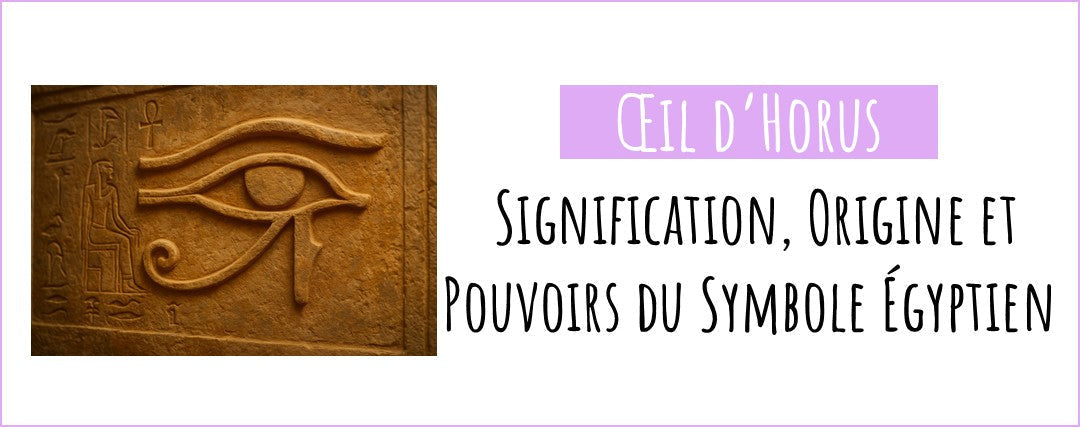
Eye of Horus: Meaning, Origin, and Powers of the Egyptian Symbol
A mystical symbol steeped in history, the Eye of Horus, sometimes called the Egyptian eye, is as intriguing as it is fascinating. Present in pharaohs' tombs, on ancient papyri, or in sacred amulets, this thousand-year-old symbol is one of the most powerful in all of Egyptian mythology. Used today in tattoos, jewelry, or as a decorative object, it continues to embody spiritual protection, healing, and clairvoyance.
But what is the meaning of the Eye of Horus? What is the difference between the Eye of Ra and the Wadjet eye? What are the symbolic powers attributed to this famous Egyptian symbol? In this article, we dive into the heart of mythology to reveal the secrets of a sacred emblem, still used today as an Egyptian amulet or symbol of protection.
From its mythological origins linked to the god Horus to its contemporary use in Eye of Horus tattoos, discover the history, spiritual meanings, and modern applications of a symbol as ancient as it is mysterious.
What is the Eye of Horus?
A profound spiritual meaning
The Eye of Horus, also called the Egyptian eye or Wadjet symbol, is one of the most recognizable emblems of ancient Egypt. Represented by a stylized eye with harmonious shapes, it embodies both divine protection, physical healing, and spiritual clairvoyance. Its popularity in spiritual beliefs and practices has never waned, enduring through the ages to the present day.

This sacred symbol was used to ward off evil and strengthen the vital force of the wearer. As an Egyptian amulet, it protected both the living and the deceased in the afterlife. Nowadays, it continues to be perceived as a lucky charm and a tool for energetic protection, especially among those interested in esoteric symbols or ancient spirituality.
In modern popular culture, the Eye of Horus is frequently associated with mystical tattoos, protective jewelry, or even esoteric decoration. But its profound meaning goes back much further, to the very heart of the mythology of the Egyptian gods.
The Wadjet eye: a name with multiple interpretations
The Eye of Horus is also known as the Wadjet eye, which means "intact," "complete," or "restored" in ancient Egyptian. This term refers directly to the legend in which the eye of the god Horus is injured, then healed by divine magic. The Wadjet eye is therefore a symbol of regeneration, repair, and the restoration of order.
It is essential to note that the Wadjet eye is not just a simple drawing or an aesthetic accessory. It was considered by the ancient Egyptians to be a true instrument of spiritual protection, often engraved or carved into tombs, funerary jewelry, or ritual objects. Wearing an Eye of Horus piece of jewelry or getting this symbol tattooed was a deeply symbolic and spiritual act.
Some distinguish the Eye of Ra from the Eye of Horus—a nuance we will address later—although in popular culture, the two are often confused. One embodies solar power, the other lunar light and wisdom. This ambiguity is part of what makes this Egyptian symbol so captivating through the ages.
Mythological origin of the Eye of Horus
The battle of Horus against Seth
To understand the true spiritual meaning of the Eye of Horus, one must dive into the heart of Egyptian mythology. The story begins with the death of the god Osiris, murdered by his own brother Seth, who was greedy for power. Horus, the legitimate son of Osiris, then decides to avenge his father and confront Seth in a series of titanic battles to restore balance to the divine kingdom.

During this mythical duel, Horus loses his left eye. It is mutilated, broken into several pieces. Thanks to the help of the god Thoth, considered the master of wisdom and magic, the eye is reconstituted. It is this miraculous regeneration that makes the Eye of Horus or Wadjet eye a powerful symbol of repair, healing, and spiritual reconstruction.
The fact that the eye was "repaired" also symbolizes the restoration of cosmic order after the chaos sown by Seth. It becomes an emblem of balance, justice, and continuity, widely used in funerary rites, talismans, and Egyptian religious symbols.
Osiris, Anubis, and the power of restoration
The presence of the Eye of Horus in stories linked to Osiris does not stop at the simple act of vengeance. After having reconstituted his eye, Horus offers it to his father Osiris as a symbol of healing, filial love, and regained power. This highly symbolic gesture illustrates how the Egyptian eye transcends a mere magical object: it becomes the very embodiment of the divine vital force.
In some texts, it is the god Anubis, master of mummification and guardian of the passage to the afterlife, who uses the repaired eye to help with the resurrection of Osiris. This facet of the myth reinforces the idea that the symbol possesses a true power of rebirth and spiritual transformation, still associated today with modern esoteric practices.
Whether in funerary stories, wall frescoes, or objects found in tombs, the Wadjet eye is omnipresent. It embodies both the memory of the ancient gods and the power of their spiritual heritage, still evoked in Eye of Horus jewelry and contemporary tattoos.
Differences between the Eye of Horus and the Eye of Ra
Two eyes, two symbols
A frequent confusion surrounds the Eye of Horus and the Eye of Ra. While these two Egyptian symbols seem visually similar, they actually represent opposing forces in mythology. The Eye of Horus, also called the Wadjet eye, is a symbol of healing, protection, and restoration. It is linked to the moon and to calming, regenerating, spiritual power.
Conversely, the Eye of Ra is associated with the sun, fire, destruction, and divine vengeance. Ra, the supreme solar god, used his eye to punish his enemies and maintain order through force. This symbol embodies offensive power, authority, and celestial domination.

While the Eye of Horus heals and rebuilds, the Eye of Ra attacks and consumes. They thus form a perfect duality in Egyptian symbolism: the lunar feminine versus the solar masculine, regeneration versus repression, benevolence versus divine anger.
The left eye and the right eye: symbolic opposition
This difference is also manifested in the orientation of the two eyes. According to tradition, the left eye is that of Horus: it represents the moon, the night, intuition, and inner wisdom. It is linked to the Wadjet symbol, as used in Eye of Horus tattoos or spiritual jewelry.
The right eye, meanwhile, is generally attributed to Ra. It is the solar eye, embodying the light of day, raw power, and creative but also destructive energy. Thus, even if some objects combine the two eyes to symbolize cosmic balance, their roles remain quite distinct.
In modern practice, this distinction is often ignored. Many speak of the Eye of Ra and Eye of Horus as one and the same sign. Yet, understanding their complementarity allows one to fully appreciate the richness of Egyptian symbols and their influence even in current esoteric traditions.

Symbolism and powers attributed to the Egyptian eye
Protection, healing, and clairvoyance
Since antiquity, the Eye of Horus has been considered a powerful symbol of spiritual protection. In pharaonic tombs as in ritual objects, it acts as a shield against evil forces. This power of protection is still claimed today by those who wear it as jewelry or as an Eye of Horus tattoo.
But the Egyptian eye is not limited to defense. It also represents healing, both on a physical and symbolic level. This curative dimension comes directly from the myth: after having been broken, the Eye of Horus is repaired and becomes even stronger. It therefore symbolizes resilience, the ability to rise again after an ordeal.
Finally, the eye is associated with clairvoyance and intuition. It is said to grant access to deep inner wisdom, to perceive what ordinary eyes cannot see. In certain esoteric traditions, it is even compared to the third eye, a channel to the spiritual world.
The power of symbols in ancient Egypt
In Egypt, magical symbols were omnipresent. Every motif, every figure had a sacred meaning, often used in amulets or funerary texts. The Wadjet eye, with its recognizable shape, was among the most powerful Egyptian symbols, alongside the Egyptian scarab, the ankh, or the cross of life.

This symbolic power was not limited to the religious elites. The common people also used Egyptian amulets engraved with the Eye of Horus to protect themselves from illnesses, accidents, or the evil eye. To wear the Eye of Horus was to affirm one's trust in an invisible, benevolent force, capable of guiding and watching over oneself.
Even today, many practitioners of New Age, Wicca, or alternative spiritual traditions use this symbol in their rituals. It embodies a gentle but powerful protection, based on balance, harmony, and inner light.
The Eye of Horus in ancient Egypt
Use in Egyptian amulets
In ancient Egypt, the Eye of Horus was much more than a simple religious symbol. It was an integral part of daily life, used in Egyptian amulets worn by the living and placed with the dead. These talismans sculpted in faience, gold, lapis lazuli, or semi-precious stones were often associated with other symbols of protection like the Egyptian scarab or the knot of Isis.
It was believed that the Wadjet eye protected the wearer against illnesses, malevolent spirits, and the forces of chaos. It was placed on mummies, sewn into the bandages, or slipped between the layers of linen to accompany the deceased on their journey to the afterlife. Thus, it served both as a funerary amulet and a symbol of rebirth.
The Egyptians attributed an almost mathematical value to this symbol. The eye was divided into six parts, each representing a human sense (sight, hearing, taste, etc.). This representation was used to teach concepts related to cosmic harmony and spiritual completeness.

Presence on sarcophagi and sacred temples
The Egyptian eye is found engraved or painted on countless religious artifacts: sarcophagi of pharaohs, temple columns, funerary stelae, ritual instruments. In the tombs of the Valley of the Kings, the Eye of Horus features prominently on wall frescoes alongside Egyptian gods like Osiris, Anubis, or Thoth.
These representations were not decorative. They were part of a symbolic system intended to guarantee the passage of the deceased to the kingdom of Osiris. The gaze of the Wadjet eye served to ward off evil, but also to watch over the heart of the deceased during the weighing of the soul, a key moment in the Book of the Dead.
The simple act of looking at or being seen by the Eye of Horus was enough to strengthen the bond between man and the divine. It is this function of sacred mediator that continues to fascinate enthusiasts of Egyptian symbols and modern esotericism, whether they wear this symbol as a tattoo or as an Eye of Horus piece of jewelry.
The Eye of Horus in modern cultures
Eye of Horus tattoo: meaning and popularity
Over time, the Eye of Horus tattoo has become a true phenomenon, as much for its aesthetic aspect as for its profound meaning. It attracts those seeking to display a form of personal protection, a connection to the sacred, or a visual reminder of resilience in the face of life's trials. It is a motif frequently associated with alternative spirituality, mystical arts, or even the quest for self.
Some choose to get the Eye of Horus tattooed on their wrist, nape, chest, or even on their back, often accompanied by other Egyptian symbols like the scarab, the cross of life, or portraits of Egyptian gods such as Anubis or Osiris. The placement of the tattoo is sometimes chosen based on the area to be symbolically "protected."

The popularity of the Egyptian eye tattoo also comes from its balanced aesthetic. Its geometric lines, its symmetrical shape, and its expressive gaze make it a motif that is both powerful and elegant. For many, it acts as a modern talisman, a constant reminder of their inner strength and their ability to overcome obstacles.
Jewelry, decorations, and spiritual objects
Besides tattoos, the Eye of Horus is today applied to many everyday objects. It figures notably among the most popular spiritual jewelry, worn for its symbolic meaning as much as for its aesthetic. It is found in the form of pendants, bracelets, rings, or earrings, sometimes inlaid with natural stones, hand-engraved, or fashioned in silver, steel, or gold.
The Eye of Horus piece of jewelry is often chosen as a talisman of protection. It is worn daily to ward off negative energies, boost self-confidence, or recall a personal spiritual journey. Each model can convey a different meaning: some prioritize discretion, others opt for more imposing designs with strong symbolic value.

At our shop, every Eye of Horus piece of jewelry is selected with care to combine authentic symbolism and contemporary design. Whether you are looking for protective jewelry to give as a gift or to wear for yourself, you will find pieces that embody both the spiritual heritage of ancient Egypt and a modern aesthetic suited to all styles.
More and more people are associating their Egyptian eye bracelet with personal intentions: protecting a project, navigating a life transition, or simply feeling connected to an ancestral tradition. Some combine them with crystals or other sacred symbols, thus creating a personalized spiritual object that carries meaning.
In addition to jewelry, the symbol is also used in esoteric decoration: wall art, tapestries, candles, or incense burners adorned with the sacred eye. These decorative elements help to create a protective and inspiring atmosphere in a living room, workspace, or meditation corner.
The Eye of Horus in other spiritual traditions
The Eye of Horus and contemporary esotericism
Beyond Egyptian mythology, the Eye of Horus has found a prominent place in many modern esoteric traditions. In New Age movements, it is often compared to the third eye in Hinduism, supposedly representing extrasensory perception and access to higher consciousness. Some practitioners of meditation or spiritual visualization use it as a focal point to open intuition or promote energy healing.
In other Western spiritual currents, the Egyptian eye is associated with Freemasonry, although this connection is controversial and often fueled by conspiracy theories. Nevertheless, the idea of an all-powerful eye watching over the world fits into a tradition of universal symbols linked to divine wisdom, hidden knowledge, and inner truth.
This symbol is also used in disciplines such as sacred geometry or contemporary shamanic practices. Its form, at once organic and structured, evokes a cosmic harmony that transcends cultures and beliefs.
Connection with Islam, the New Age, and Freemasonry
In certain mystical branches of Sufi Islam, there are symbolic references similar to the Eye of Horus, although it is never cited directly. The idea of a divine gaze, of an invisible protective presence, resonates with what the Wadjet eye represents in Egyptian culture.
In contemporary esoteric movements, the Eye of Horus is sometimes interpreted as a key for activation toward spiritual awakening. It then symbolizes not only vigilance but also the awakening of consciousness, a central theme of the New Age. It is common to find it on personal development books, oracle cards, or meditation apps.
Finally, while modern Freemasonry prefers the Eye of Providence, which is often confused with the Eye of Ra, there are iconographic parallels. The notion of an omniscient eye, hidden truth, and an invisible protective force are common threads linking these symbols across civilizations.
How to use the Eye of Horus today?
As an amulet or protective piece of jewelry
In the contemporary world, the Eye of Horus remains a powerful tool for energy protection and spiritual connection. Many choose to wear it in the form of jewelry or a talisman, as a visual reminder of their inner strength or their connection to higher forces. It is also used to counter negative influences, ward off malicious intentions, or simply establish a feeling of inner security.
The Eye of Horus bracelet, for example, is often worn on the left wrist—the heart side—to strengthen its protective reach. The Egyptian eye pendant can be placed on the chest, an area associated with vital energy and wisdom. Some prefer to slip their jewelry into a bag or under a pillow, creating an invisible barrier against outside disturbances, particularly during sleep.
Those who wish to personalize their experience associate the Eye of Horus amulet with other spiritual elements: incense, semi-precious stones, essential oils, or prayers of intention. The goal is to create a personal ritual focused on protection, healing, or inner revelation.
In meditation or symbolic decoration
The Egyptian eye is also used as a visual aid in meditation. Fixing one’s gaze on this symbol for a few minutes is said to activate energy circuits that promote concentration, grounding, and spiritual openness. It is a practice that appeals to beginners and confirmed practitioners alike in the field of personal development.
In decoration, it is often placed at the entrance to a house, above a bed, or in a living room, with a clear intention: to protect the space and diffuse positive vibrations. Some incorporate the symbol into wall compositions mixing sacred geometry, chakras, or celestial representations. Its captivating visual effect immediately creates a feeling of order and balance.

Whether you are drawn to the Eye of Horus for its symbolic meaning, its protective power, or simply for its graphic beauty, it can become a precious daily ally. You simply need to use it with intention and respect, in a spirit of conscious connection. Discover our collection of Eye of Horus jewelry and choose the piece that most resonates with your personal path.
Conclusion: An eternally living symbol
From the banks of the Nile to the wrists of those who wear it today, the Eye of Horus has traversed the millennia without ever losing its symbolic power. Whether used to protect, meditate, decorate an interior, or simply affirm one’s connection to the sacred, this Egyptian symbol continues to fascinate and inspire across the world.
Bridging spirituality, mythology, esotericism, and contemporary fashion, the Egyptian eye occupies a unique place. It connects the past to the present, the visible to the invisible, and injury to healing. It is this richness of meaning that makes it such a powerful object, beyond any trend.
If you feel the call of this symbol, do not hesitate to invite it into your daily life. Our collection of Eye of Horus jewelry has been designed for those who seek to combine aesthetics and protective energy, with unique pieces inspired directly by ancient knowledge.
Because more than just a piece of jewelry or a graphic motif, the Eye of Horus is a message. A message of resilience, balance, and inner light. It is up to everyone to bring it to life in their own way.
FAQ – Eye of Horus
What is the difference between the Eye of Horus and the Eye of Osiris?
There is no actual Eye of Osiris in Egyptian mythology. However, as Osiris was the father of Horus, some confuse the two figures. The Eye of Horus symbolizes protection and healing, and it is sometimes associated with Osiris in funerary rituals.
Is the Eye of Horus a satanic symbol?
No, the Eye of Horus has no connection to Satanism. It is a symbol of light, protection, and wisdom originating from ancient Egypt. Confusions often arise from modern associations or baseless conspiracy theories.
Does the Eye of Horus bring bad luck if used incorrectly?
Traditionally, the Egyptian eye is a beneficial symbol. It does not bring bad luck. However, in certain esoteric beliefs, it is recommended to wear it with intention and respect, like any symbolically charged spiritual object.
How do you cleanse or “recharge” an Eye of Horus piece of jewelry?
For those who associate it with an energetic dimension, an Eye of Horus piece of jewelry can be purified with sage smoke, salt, or moonlight. These actions come from modern spiritual practices, particularly in the field of lithotherapy.
Can you give an Eye of Horus as a gift?
Yes, giving an Eye of Horus bracelet or pendant is a very strong symbolic gesture. It signifies that you wish to pass on protection, foresight, and benevolence to the person who will receive it.
Similar Articles:
















