
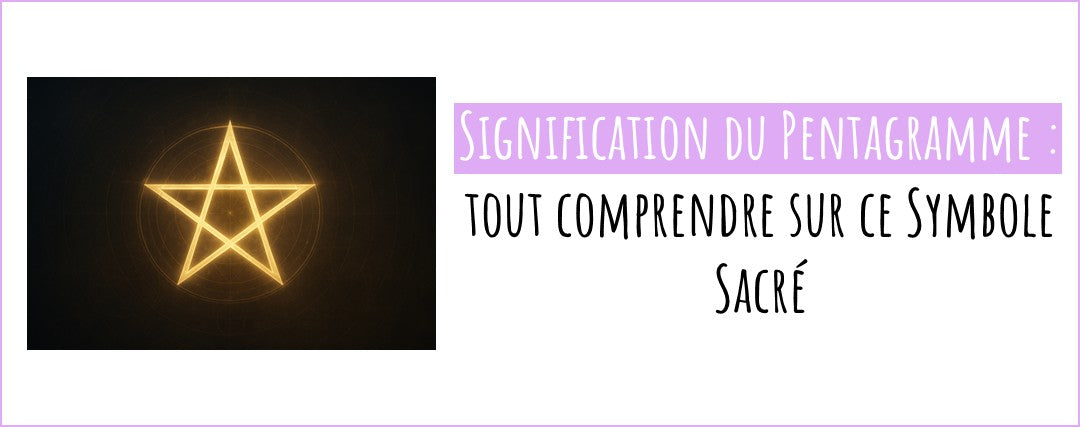
Meaning of the Pentagram: Everything You Need to Know About This Sacred Symbol
Since the dawn of time, esoteric symbols have fascinated humanity. Among them, the pentagram, also known as the five-pointed star, occupies a special place. Powerful, mysterious, and often misunderstood, it embodies sacred geometry, spiritual protection, and the oldest magical traditions all at once. But what does this pentagram symbol really mean? Is it merely a graphic design or a tool for connection between humans and invisible forces?
Often confused with the pentacle or wrongly associated with Satanism, the pentagram has traversed the centuries, from ancient Kabbalah to contemporary witchcraft circles. It is found in grimoires of white magic as well as in sacred artworks, engraved on jewelry, or tattooed on the skin as a symbol of protection.
However, there are several meanings of the pentagram. Depending on its orientation, its form, or the context in which it is used, it can represent balance, natural elements, the human body, or conversely, incite fear as a satanic star. This apparent paradox fuels fantasies, misunderstandings… but also a profound symbolic richness.
In this comprehensive article, we will explore in detail the meaning of the pentagram: its origins, its spiritual uses, and its aesthetic value in sacred geometry. We will also see why the inverted pentagram has a very different meaning from the upright pentagram, and how the interpretation varies according to tradition.

If you are interested in powerful symbols, energetic protection, or are looking to understand the deep meaning of this five-pointed star, you have come to the right place. Prepare to dive into a universe where sacred science, ancient myths, and spiritual practices meet.
What is a pentagram?
Simple definition and forms of the pentagram
The pentagram is a five-pointed star formed by a single uninterrupted line. It is a closed geometric figure where each line flows into the next, creating an effect of continuity and visual harmony. This particular path symbolizes unity, wholeness, and the fluid circulation of energy. Unlike a pentagon, which is a five-sided polygon, the pentagram forms a star with clearly defined points.
The structure of the pentagram is such that each intersection creates internal angles of 36°, 72°, and 108°—numbers that resonate strongly in sacred geometry. This sacred shape is not merely aesthetic: it is imbued with symbolism in many cultures around the world.
The word "pentagram" comes from the Greek pente (five) and gramma (line or letter), which literally means "five lines." It is sometimes called a "pentalpha" because it can be seen as five intertwined Greek alpha letters. In Western tradition, the pentagram is often depicted with one point facing upward, which gives it a high and positive spiritual meaning.

There are also variants of the pentagram: some are decorated, others are enclosed within a circle (which turns them into pentacles), while others are inverted to express a radically different symbolism.
Geometric symbolism of the pentagram
Geometrically, the pentagram is considered a figure of perfection. Each segment is proportioned according to the golden ratio, that mathematical constant often associated with divine beauty and cosmic harmony. This presence of the golden ratio in the pentagram's design makes it a preferred subject of study in schools of sacred geometry.
The structure of the pentagram also reflects the cycle of life and nature. With its five branches, it represents the five fundamental elements in many esoteric traditions: earth, water, fire, air, and spirit (or ether). This symbolic reading of the pentagram makes it a central esoteric symbol in several mystical schools, including Kabbalah and ceremonial magic.
Some see in the pentagram a blueprint of the perfect human: a head, two arms, and two legs aligned with the universe. It is this anthropomorphic correspondence that made it a symbol of man in balance with cosmic laws, as shown in Leonardo da Vinci's famous drawing, the Vitruvian Man, although the latter is inscribed within a circle rather than a pentagram.
In initiatory traditions, the pentagram is viewed as a gateway. A gateway to what? To knowledge, to the sacred, to oneself. It symbolizes the overcoming of matter through the elevation of the spirit, but also self-mastery, as each branch represents an essential component of the human being that must be balanced.
The inverted pentagram breaks this dynamic. When the point is turned downward, interpretations shift: the symbol is perceived as an inversion of the natural order, which we will elaborate on later in the article. This is why it is so important to understand the context and intent behind the use of every pentagram.
Whether used as a symbol of protection, a ritual tool, a decorative element, or a spiritual motif, the pentagram remains a condensation of powerful symbols, carrying an energetic charge that goes beyond mere appearances.

Origins and history of the pentagram
The pentagram in ancient civilizations
The pentagram is one of the oldest esoteric symbols known to humanity. Traces of it date back to 3000 BC in Mesopotamia, engraved on Sumerian tablets. At that time, it did not yet carry the spiritual connotations we know today, but it already represented an order, a direction, a meaning. Some inscriptions interpret it as a symbol of the four cardinal directions, with a fifth point facing upward: the celestial world.
In ancient Egypt, although the pentagram was not as central as the ankh or the Eye of Horus, five-pointed shapes were associated with protection and eternal life. Priests sometimes used diagrams based on pentagonal stars in their celestial representations.
Among the Greeks, it was with Pythagoras that the pentagram took on a major mathematical and symbolic dimension. For the Pythagoreans, the pentagram was the symbol of health, human perfection, and the cohesion of the universe. This is no coincidence: the design of the pentagram is based on the golden ratio, present in the ideal proportions of the human body and nature. The pentagram thus became a geometric representation of the living in harmony with the cosmos.
In Kabbalah, the Jewish mystical tradition, the pentagram appears later as a figure of connection between the different planes of consciousness. There, it symbolizes the union of the forces of creation, notably the five lower sephirot that correspond to the earthly elements. It is then viewed as a key to understanding the divine through the structure of the world.
The pentagram through the ages
During the Middle Ages, the pentagram became a symbol of protection against evil spirits and harmful influences. It was often engraved on doors, weapons, or clothing, particularly in Christian communities, where it represented the five wounds of Christ. At that time, far from the sulfurous image attributed to it today, the pentagram was a Christian symbol of faith and salvation.
It was over time, with the rise of occultism and ceremonial magic in Europe, that the pentagram gained in symbolic complexity. Renaissance alchemists and mages used it to represent the elements, invisible forces, and the hidden order of the universe. It then became a recurring figure in grimoires and magical rituals, particularly in witchcraft circles. Sometimes referred to as a pentagram of protection, it is charged with energy depending on the direction in which it is drawn or activated.
In the 19th century, secret societies and initiatory orders like the Golden Dawn or the Hermetic Order of the Pentagram (yes, it even inspired organization names!) continued to explore its magical virtues. The pentagram became a tool for visualization, energy channeling, and even guided meditation. At this stage, two uses were already clearly distinguished: the upright pentagram, used in white magic and spiritual protection, and the inverted pentagram, often associated with more transgressive practices, or even witchcraft.

Modernity, with its parade of horror films, rock icons, and role-playing games, subsequently distorted the perception of this symbol. The pentagram is then often wrongly perceived as a satanic pentagram, a satanic star associated with fear, rebellion, or evil. This cultural shift has eclipsed all the richness and depth of the original symbol, which we will restore in the coming sections.
The different meanings of the pentagram
Spiritual and esoteric meaning
The pentagram, in its purest form (point facing upward), is above all a profound spiritual symbol. It represents harmony between man and the universe. The five points of the star are generally associated with the five elements: earth (stability, grounding), water (emotions, intuition), air (thought, intellect), fire (will, transformation), and spirit (connection to the divine). The order of the points and their orientation reflect a universal energetic balance, which is very present in sacred geometry.
In initiatory traditions like Kabbalah, or in certain branches of Western magic, the pentagram is used to trace a sacred circle or channel energy during rituals. It then becomes a symbolic energetic map, with each activated point representing an aspect of oneself to be balanced. This esoteric dimension makes the pentagram much more than just a drawing: it is a tool for inner transformation.
Neoplatonic and Hermetic schools also considered the pentagram as the microcosmic representation of the human being in the universe. Man, with arms and legs spread, the point of the star above his head, embodies this correspondence between the physical body and the cosmic order.
This spiritual reading makes the pentagram a symbol of light, consciousness, and evolution. It is not a static motif, but a visual guide used for meditation, energetic protection, or the search for balance between the different aspects of the being.

The pentagram of protection
One of the most widespread uses of the pentagram, yesterday as today, is that of a symbol of protection. Worn as an amulet, engraved on a stone, drawn on a door, or traced in the air, it serves as a barrier against negative influences. In many traditions, the pentagram is activated by a specific intention: to ward off malevolent entities, create a pure vibratory field, or reinforce the security of a sacred space.
Pentagrams of protection can be simple or enriched with additional symbols (such as letters, runes, colors, or divine names). It is sometimes called a pentacle when the pentagram is inscribed within a circle. The circle represents continuity, unity, and the concentration of energy. Together, the pentagram and the circle form a symbolic fortress used in many white magic rituals.
This type of pentagram is very popular in Wiccan, pagan, and neo-spiritual circles. It does not symbolize domination or power, but rather preservation, peace, and inner security. Many people today wear a pentagram-shaped pendant, or decorate their homes with this symbol, not out of strict religious belief, but to benefit from its protective energy.
Inverted pentagram: meaning and controversies
The inverted version of the pentagram, with the point facing downward, is undoubtedly the most controversial. In some ancient traditions, the inverted pentagram was not perceived as evil. It simply represented an inversion of forces: matter dominating spirit, or grounding in the physical world.
But over the centuries, this representation has been misused. Today, the inverted pentagram is widely associated with practices of black magic or darker invocation rituals. It was mainly in the 20th century, with the emergence of modern Satanism (notably via the Church of Satan founded by Anton LaVey), that the inverted pentagram became an overt emblem: it is then referred to as a satanic star or a satanic pentagram.
Most often, this symbol is accompanied by a goat's head inside the pentagram, known as the Sigil of Baphomet. This motif is used not from a purely evil perspective, but to signify a form of rebellion, radical individualism, and the rejection of traditional religious systems.
It is important to note that this shift in meaning has nothing to do with the traditional uses of the pentagram. Many esoteric or spiritual practitioners do not recognize the satanic pentagram as an authentic form of the symbol, but rather as a cultural appropriation.
- Choosing a selection results in a full page refresh.
- Opens in a new window.