
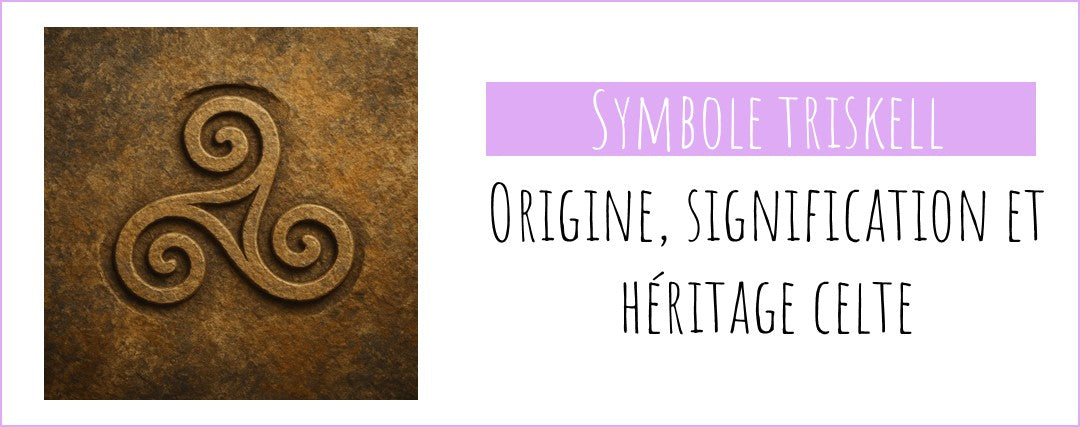
Triskel Symbol: Meaning, Breton Origin & Celtic Heritage
Ancient, powerful, and steeped in mystery, the Triskell symbol occupies a central place in Celtic symbolism and Breton identity. This triple-spiral motif, also called the triskel or triskelion, fascinates history buffs and spirituality enthusiasts alike. But what does this Breton symbol with its enchanting lines really mean? What messages has it been conveying for centuries? This article offers you a deep dive into the world of the Celtic triskel, exploring its legends, modern uses, and symbolic interpretations.

What is the Triskell?
An ancestral motif with Celtic origins
The triskel is a figure composed of three spirals joined at their center. This symbol, whose earliest traces date back over 3,000 years, is deeply rooted in Celtic culture. It is found on carved stones, pottery, as well as weapons and jewelry, primarily in Brittany, Ireland, and Scotland. It is often classified among the iconic Breton logos, alongside the ermine and the Gwenn ha Du, the Breton flag.
One spelling, several variations
The word can be found written in different ways: triskel, triskell, or even triskelion. These variations do not change the meaning but rather reflect linguistic and regional adaptations. Whether you speak of a triskell or a triskel, you are always referring to the same symbolic Breton emblem. We will delve further into this in the section "Differences between Triskel, Triskell and Triskelion."
Triskel meaning: a multiple symbolism
Three branches, three dimensions
The triskel is based on the repetition of the number three, which is highly symbolic in Celtic traditions. This form evokes the balance between three forces, three worlds, or three principles. The spiritual meaning of the triskel can therefore vary depending on the context:
- Body, soul, and spirit
- Past, present, and future
- Earth, water, and fire
- Birth, life, and death
This wealth of interpretations makes the triskel a symbol of Brittany that is as complex as it is fascinating. It is not limited to a simple design: it is a visual synthesis of powerful concepts.
Triskel: spiritual and energetic meaning
In esoteric practices or Celtic spirituality, the triskel is used as a tool for centering, harmonizing energies, and protection. It is sometimes carved onto personal items, worn as jewelry, or incorporated into rituals. The meaning of the triskel then takes on a sacred dimension: that of the union between man and the forces of nature.
The Triskell in Breton culture

A strong identity symbol
In Brittany, the triskell is omnipresent. It can be found in corporate logos, on license plates, in crafts, or on clothing. It symbolizes deep roots in a territory and an ancient culture. For many Bretons, wearing this Breton symbol is a way to affirm their identity, bridging the gap between modernity and ancestral traditions.
A motif adopted in jewelry and accessories
The triskell piece of jewelry is very popular. Necklaces, rings, bracelets, and earrings are inspired by this motif. These creations combine aesthetics and meaning. For lovers of powerful symbols, it is also a way to carry a part of Celtic symbolism with them.
Symbolism of the Triskel in Celtic history

A symbol common to Celtic peoples
The triskel is not unique to Brittany: it is found throughout the entire Celtic world. In Ireland, Scotland, or Wales, it holds a central place in the collective imagination and beliefs. Its structure of three spirals aligns with the Celts' preference for the repetition of the number three, often associated with perfection, balance, or divinity. This trinitarian dimension is a pillar of Celtic symbolism, where everything is viewed in tripartite interaction.
A universal meaning through time
The meaning of the triskel has evolved over the centuries, but its core remains stable: it symbolizes the interdependence of elements. The outward-facing spirals suggest movement, growth, and expansion. They convey a dynamic of life, far from stagnation. In certain traditions, the triskel is attributed a function as a Celtic protective symbol, capable of repelling negative energies and guiding the spirit.
The Triskel today: between tradition and modernity
A comeback in trends
The triskell has seen a resurgence of interest in recent years. This comeback is explained by a growing quest for meaning, spirituality, and grounding. Facing a world often perceived as too fast-paced or disconnected, many individuals are turning to ancient, meaningful symbols. The Celtic triskel is one of them. It is becoming an element of decoration, fashion, or art, while retaining its depth.
Contemporary use and marketing pitfalls
Be careful, however, with certain appropriations. The triskel is sometimes used as a mere ornament, emptied of its essence. It is important to learn about the triskell meaning and respect its origins. Wearing the triskel is not an insignificant gesture: it is also a cultural and symbolic commitment.
How to integrate the Triskell into your daily life
Choosing a triskel for your decoration
Decorating your home with a triskell symbol can give a touch that is both mystical and soothing to a space. Paintings, wall hangings, and wood or metal objects representing the triskel are available in many Celtic shops. By choosing these elements, one brings not only beauty but also profound meaning to their living space. The symbol of Brittany then becomes a bridge between tradition and modern well-being.

Creating a logo inspired by the triskell
Many Breton brands and artisans create Breton logos inspired by the triskell. It can evoke sustainability, a connection to the territory, or a holistic approach to the world. If you are considering using the triskel in your visual identity, ensure you fully understand the triskel symbolism to respect its reach and avoid any clumsy appropriation.
The Triskell in jewelry: aesthetics and symbolism
A piece of jewelry charged with meaning
Wearing a triskell piece of jewelry is more than just an aesthetic choice: it is adopting a symbol rich in meaning and tradition. Each branch of the triskel evokes fundamental elements—such as earth, water, and fire—or even profound concepts such as the balance between the body, the spirit, and the soul. As a bracelet, pendant, earring, or ring, it becomes a discreet and personal talisman. Some handcrafted jewelry even highlights the rotation of the motif to recall the perpetual movement of life.
A symbolic gift
Giving a triskel as jewelry is a powerful gesture. It can symbolize protection, guidance, or balance. It is also an excellent way to pass on a piece of Celtic symbolism, to pay homage to one's Breton roots, or to anchor a spiritual intention. In certain cultures, the triskel is even used during rites of passage or key moments in life: birth, a change in path, or personal rebirth.

How to choose your triskel jewelry
There is a wide variety of models: some are made of silver, others of bronze or wood. Some jewelry includes engravings or natural stones to reinforce its energy. The choice will depend on your intention: are you looking for an aesthetic object, a spiritual reminder, or a symbol of cultural grounding? Whatever your goal, the triskell remains a powerful and meaningful choice.
The Triskell in tattooing: a symbol engraved on the skin
Why choose the triskell as a tattoo?

More and more people are choosing the triskell as a tattoo design. This choice can symbolize a spiritual quest, a deep bond with nature, or an assertion of Breton identity. It is an ancient, universal, and timeless symbol—making it an ideal motif for a permanent engraving. The triskel expresses evolution, balance, and the cycle of life, values that many who choose tattoos wish to embody or be reminded of daily.
Varied placements and styles
The triskell tattoo can be done in a very minimalist way or in a more elaborate style, with shading effects, complementary Celtic patterns, or even floral elements. It can be positioned on the forearm, back, calf, or even behind the ear. Its natural symmetry makes it an aesthetic motif that is easy to integrate into a larger composition. Some tattoo artists specializing in Celtic symbolism create very fine works that respect traditional proportions.
A personal commitment
Getting a triskell symbol tattooed is often the result of a personal journey. It can mark an important milestone, an inner rebirth, or a desire to stay true to deep values. Much more than a Breton emblem, it becomes an inner compass, a daily reminder of cycles, movement, and unity. Like any symbolic tattoo, it deserves reflection and knowledge of its true significance.
Triskel and modern spirituality
A meditation tool

The triskell is sometimes used as an aid for meditation. By focusing on the spirals, some people manage to center themselves, calm the mind, or explore their inner selves. The spiritual meaning of the triskel then becomes a lever for personal transformation. Whether one is a follower of Buddhism, Druidism, or other practices, this symbol easily integrates into an inner path.
Triskel and personal energy
In alternative medicine, some practitioners associate the triskell with notions of energetic balance. It is sometimes used to harmonize chakras, balance polarities, or strengthen intuition. Even if these approaches are not always scientifically validated, they illustrate the appeal of the triskel for those seeking a connection between the visible and the invisible.
Triskel, identity, and cultural grounding
A marker of Breton identity
In the current context where many cultures seek to preserve their heritage, the Breton symbol that is the triskell plays a central role. It allows for the revival of collective memory, strengthens belonging to a people, and conveys a message of pride. For younger generations, it can be a landmark, a way to stay connected to their roots.
Between assertion and heritage
The Celtic triskel has been appropriated at different times for political, cultural, or spiritual reasons. In all cases, it remains a strong marker of Celtic and Breton culture. Its presence in festivals, tattoos, clothing, or artistic works testifies to its unifying power. It is not limited to a simple image: it is a visual cry of grounding and transmission.
Differences between Triskel, Triskell and Triskelion

Orthographic variations or differences in meaning?
The terms triskel, triskell, and triskelion are used interchangeably, but each possesses a particular resonance depending on the regions or circles. The word triskel is of Greek origin ("triskeles" meaning "three-legged"), while triskell is a French-influenced spelling often associated with contemporary Brittany. As for triskelion, it refers to an older or more scholarly writing. In reality, all these terms point toward the same triskell meaning: a trinitarian symbol, universal and deeply rooted in Celtic history.
Meaning of the triskelion in ancient writings
Traces of the triskelion can be found in medieval manuscripts and Gallo-Roman engravings. It was often associated with gods or mythological figures. In some texts, the triskelion meaning is linked to natural cycles—such as the seasons or lunar phases—and to initiatory rituals. It then represented a path of knowledge, a gateway to wisdom.
Triskel and modernity: a living symbol
From traditional to contemporary design
More and more creators are reinterpreting the triskell symbol with a contemporary approach. We see it in graphic design, architecture, fashion, or even tattooing. The challenge is to maintain the symbolic strength of the triskel while modernizing it. This testifies to its ability to span centuries without losing relevance. Celtic symbolism thus becomes a source of inspiration for innovation and creation.
A bridge between past and future
The Breton symbol that is the triskel acts as a link between eras. It embodies the memory of the ancients while adapting to current needs. It inspires people in search of roots, coherence, or guidance. In a world in constant flux, Celtic symbols like the triskel offer stability, direction, and an invitation to contemplation.
Conclusion: Why the Triskell still fascinates today
The triskell symbol has lost none of its power. It continues to seduce with its graphic beauty, symbolic depth, and multiple interpretations. Whether one is interested in the meaning of the triskel, its Breton roots, its spiritual dimension, or its aesthetics, it opens a door to a world that is ancient yet still current. Adopting this Breton emblem means embracing a part of history, a philosophy of life, and a connection to what is essential. In an era marked by speed and noise, the triskel reminds us that strength often resides in balance, circular movement, and simplicity full of meaning.
FAQ about the Triskell Symbol
What is the difference between a triskell and a triquetra?
The triskell is a three-spiral symbol often representing movement and cycles, whereas the triquetra is a three-looped knot symbolizing unity. Both are of Celtic origin but have distinct meanings and shapes.
Can the triskel be worn by everyone?
Yes, the triskel is not reserved for a specific caste or people. It can be worn freely as jewelry, a tattoo, or a decorative motif, provided its cultural and spiritual significance is respected.
Is the triskell a religious symbol?
Originally, the triskell was a spiritual symbol in Celtic traditions. It does not belong to an official religion, but it is sometimes integrated into modern Neo-Druidic or esoteric practices.
Can one use a triskel as a company logo?
Yes, many Breton companies or those inspired by Celtic culture use the triskel as part of their visual identity. It is recommended to fully understand its meaning before using it commercially.
What is the significance of the direction of the spirals?
According to traditions, a triskelion turned to the right (clockwise) is linked to solar energy, action, and life, while an inverted triskelion can evoke introspection or the invisible world. The direction therefore has symbolic importance.
Related Articles:
















