Roots and branches of the Tree of Life: what do they represent?
The roots and branches of the Tree of Life allow you to read the pattern as a relationship between what supports and what grows. The former can evoke a history or support; the latter openness, connections, or possibilities. This reading is not, however, a code imposed on every drawing.
To understand your own interpretation, look at how the tree is represented: visible or discreet roots, a central trunk, branches that extend or join a border. Here are some guidelines for describing these elements without confusing symbolic image, personal narrative, and prediction.
Read the structure before looking for a meaning
A drawn tree is already a selection. The artist can show what is beneath the soil, simplify the crown, or bring branches and roots together in a single form. These choices guide your attention, but they do not allow you to automatically guess the intention of the person who created the image.
Start with a simple observation: which parts are most present? Do the roots occupy as much space as the branches? Does the trunk separate two areas or visually connect them? This description avoids imposing a general definition on different compositions.

The illustrative drawing above makes the upper and lower parts of the tree visible. It does not represent all the traditions associated with the pattern. It serves here to distinguish what we see from what we choose to recognize in it.
Roots: an image of connections and support
The meaning of the roots of the Tree of Life can be built around what connects you to a history. It can be loved ones, a place, a language, a transmission, or people who helped you move forward.
This reading is not limited to biological lineage. Friends, learning, or a chosen environment can also constitute important supports. The drawing can evoke what built you without imposing a single definition of family.
Roots can also recall continuity: some things remain present when circumstances change. This does not mean that the past determines the entire future. You can keep a part of your history while deciding to give it another place.
To deepen this nuance, our article on the family symbol compares several ways of representing the links between loved ones. The tree is one possibility among others, not an obligation.
Visible or hidden roots: the drawing does not say everything
Intertwined roots can draw the eye to the relationship between several lines. You can see connections, paths that cross, or a group that supports itself. It is an interpretation, not a conclusion about the life of the person who wears this pattern.
Conversely, the absence of visible roots does not mean a lack of history or attachment. A composition may simply favor the silhouette of the trunk and branches. What is not represented must not be turned into a judgment.
This distinction is useful when you comment on a piece of jewelry, a tattoo, or a decoration. Asking "what does this drawing represent for you?" leaves more room for personal narrative than announcing a supposedly mandatory meaning.
Branches: openness and possibilities
The meaning of the branches of the Tree of Life can evoke the directions one explores. Their ramifications allow you to represent several links or several choices without reducing them to a single line.
A branch can make you think of a relationship, a project, or a possible path. It does not allow you to predict an event. The drawing can accompany a reflection on what you wish to develop, without becoming a map of what will happen.
In a very open composition, the branches seem to extend the pattern outward. In a denser crown, they create a network of details. These visual effects can feed a different reading, but they must be observed before giving them a name.
It is not necessary to attribute a distinct message to each little branch. An overall impression may be enough: movement, diversity, continuity, or simply the beauty of the lines.
The trunk: connecting rather than separating
The trunk of the Tree of Life often occupies a linking place in the reading of the pattern. It allows you to follow with your eyes a continuity between the lower and upper parts, even when they seem very different.
On a personal level, you can recognize a coherence in the midst of several influences. This idea does not require your history to be perfectly linear. A stylized tree can bring together sinuous lines, spaces, and directions that are not symmetrical.
A wide or thin trunk is also a drawing choice. It does not constitute a measure of inner strength or personal stability. The interpretation must remain a possibility offered by the image, not an evaluation of the person.
When roots and branches come together
Some drawings bring the ends of the tree together in a border. The eye can then circulate between roots, branches, and the edge. This continuity of the Tree of Life can inspire an idea of interdependence: the parts are distinct, but participate in the same composition.
Another person may prefer to see a cycle or a link between what was received and what is transmitted. It is not necessary to choose a single definitive reading. The meaning can evolve with the context in which you look at the pattern.
However, do not deduce from this shape that an object acts on its environment. A composition that evokes unity does not bring, by its mere presence, proof of protection or an energetic effect.
A personal reading, not a universal translation
The symbolism of the Tree of Life depends on the drawing, the narrative, and the context. A contemporary decorative pattern does not allow by itself to summarize all the traditions that use a tree or roots.
If an interpretation is attached to a specific culture or text, this reference must be examined separately. The word "ancient" or the commercial name of an object does not replace this work. One can appreciate a pattern without attributing to it a certain origin that has not been verified.
For a more general reading of living things and continuity, our guide to life symbols offers other images. Comparing them helps to understand what touches you especially in roots and branches.
Three questions to clarify your own interpretation
You can use the pattern of roots and branches as a starting point for a short reflection. No answer is expected, and the drawing is not a test allowing you to describe your personality.
- What people, experiences, or habits are my supports today?
- What links or projects do I want to develop?
- What continuity do I want to keep between the two?
You can write a few words or simply keep an idea. If a question does not speak to you, leave it aside. The symbol can remain decorative: it does not need to explain your whole life.
This method is also useful to accompany a gift. Explaining your intention leaves the person the freedom to recognize something different in it, rather than imposing a definition on them.
Observing these lines in a decorative object
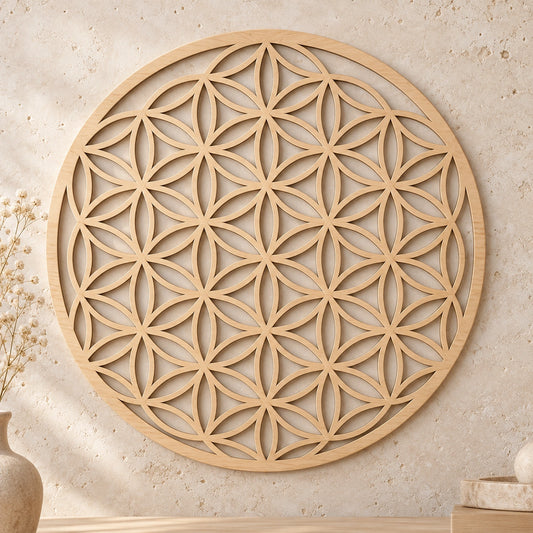
The Celtic Wooden Tree of Life features a central trunk and a network where branches and roots participate in an openwork border. It allows you to observe this dialogue of shapes in an object from the shop.

The Celtic name designates this model. It does not prove that each detail has a unique interpretation or that it summarizes an entire tradition. You can look at its lines, then freely choose what they evoke for you.
If you wish to compare other representations, the Tree of Life Decoration collection brings together different objects. The collection serves to discover the models; this article is interested in the reading of the parts of the symbol, not in their commercial classification.
Telling a connection without confining the symbol
A Family Tree of Life can recall people or a transmission, but the pattern must not force everyone to tell a happy or complete story. Connections can be chosen, transformed, or kept private.
If you give an object, a simple message may be enough: "for the supports and the paths that matter to you". It expresses your attention without claiming to know what each root or each branch represents for the other.
FAQ – Frequently Asked Questions about Roots and Branches of the Tree of Life
What do roots represent?
They can evoke a history, connections, or supports. This reading is not limited to biological family and is not imposed on all drawings.
What do branches represent?
They can make you think of openness, relationships, or possibilities. They do not allow you to predict a path or an event.
Does a drawing without roots have a negative meaning?
No. The absence of visible roots can be a simple graphic choice. It does not allow you to pass judgment on the person or their history.
Why do roots and branches sometimes come together?
This construction can suggest continuity or interdependence. The meaning depends on the context and interpretation, not on a universal rule.
Should you give a name to each branch?
No. You can appreciate the whole, recognize a few connections, or keep the pattern for its aesthetics alone.
Read the drawing before telling its story
Roots, trunk, and branches give several entry points into the Tree of Life. Observe their relationship, then retain the associations that speak to you. An interpretation can be personal and deep without becoming a certainty about the past, the future, or the lives of others.