Synchronicity: Meaning, Examples, and Spiritual Interpretation
You think of someone just before receiving their call. A word overheard seems to answer a question that has been on your mind. These encounters can give the impression of an echo between your inner life and what is happening around you. The meaning of a synchronicity lies precisely in this felt sense, which should be distinguished from proof.
What does this term cover, what place do certain spiritual readings give it, and how can you explore it without looking for instruction in every event? Here are examples and guidelines to maintain curiosity, nuance, and the freedom to choose.
What is a synchronicity?
In Carl Gustav Jung's analytical psychology, synchronicity refers to the meeting of events that appear connected by meaning, without an explainable causal relationship between them. The term therefore draws attention to a coincidence that is meaningful to the person experiencing it.
Two elements are important: events meet, and someone attributes a particular significance to them. This is not the same as demonstrating that one event caused the other. Thinking of a friend before they call is not enough to establish that your thought triggered the phone call.
In contemporary spiritual uses, the word is sometimes applied more broadly to repetitions or encounters perceived as timely. Uses vary: it is useful to clarify what is being discussed, rather than assuming that everyone shares the same definition.
Chance, coincidence, and synchronicity: what is the difference?
A coincidence describes a meeting of events. The term meaningful coincidence adds the place this meeting takes in your experience. Talking about synchronicity emphasizes this meaning, without this qualification alone constituting an explanation of the mechanism.
Chance is not necessarily synonymous with a lack of personal value. A chance encounter can move you, remind you of a commitment, or give you an idea. Its importance to you does not require that the event was specially organized for your intention.
Conversely, the feeling that a situation is extraordinary is not enough to exclude an ordinary explanation. You can welcome what touches us while leaving the question of its cause open.
Three examples to understand the felt meaning
Thinking of someone, then receiving their call
Imagine that you think back to a friend you have lost touch with at the moment they call you. The connection can surprise you and rekindle affection. You can see it as a wonderful opportunity to catch up, without concluding that your thoughts were transmitted remotely.
The context can also count: a birthday, a shared memory, or news can have led each to think of the other. These clues do not take away from the joy of the call; they simply avoid turning the emotion into proof.
Finding a theme in several conversations
You are thinking about resuming a creative activity, then the subject appears in a conversation and in a book. This repetition can make you want to clarify your project. You may also have become more attentive to this theme since it has interested you.
The useful question then becomes: what makes me want to act on what I heard? It opens up more possibilities than the assertion that an external event would order you to change your life.
Noticing a repeated time or pattern
A sequence of numbers or a design can seem to echo a period of your life. The visible pattern is real; its symbolic reading depends on the meaning you associate with it. This distinction allows you not to confuse repetition with prediction.
These examples are illustrative situations, not proof of a paranormal phenomenon. They show above all how an event that is ordinary for one person can take a striking place for another.
Spiritual reading: a felt connection, not a universal instruction
In some beliefs, spiritual synchronicity is interpreted as a sign of guidance, an invitation to listen, or an echo of the universe. This reading can have an intimate place, provided you recognize it as a belief rather than a certainty that can be imposed on everyone.
You can welcome an image of confidence without asserting that every event was sent for you. You can also appreciate a coincidence without adhering to a spiritual explanation. Personal meaning and causal explanation are not obliged to merge.
An interpretation remains freer when it takes the form of a question: "What does this encounter evoke in me?" It becomes binding if it requires you to obey, buy something, or act urgently so as not to miss a supposed protection.
Fact, feeling, interpretation: three levels to separate
To think about a meaningful coincidence, start by describing the scene as simply as possible. Then add what you felt, then the story or symbolism you associate with it. These three levels can coexist without having the same value of proof.

| Level | Example of phrasing | What it allows to say |
|---|---|---|
| Fact | I thought of a friend before their call. | Two events followed each other in my experience. |
| Feeling | This encounter surprised and delighted me. | The moment had an emotional significance for me. |
| Interpretation | I see it as an invitation to reconnect. | I choose a possible meaning, without proof of an external intention. |
This work of phrasing avoids jumping directly from "this touched me" to "I know what is going to happen." It does not require giving up the emotion; it allows you to better identify what it tells of your experience.
Why do certain repetitions mark us more?
Your selective attention can focus more easily on a theme that has become important. Once an idea is present in the mind, you can more easily spot situations that remind you of it. This offers a possible explanation for certain impressions of repetition, without automatically reconstructing every personal case.
Memory can also favor remarkable encounters rather than the many moments without particular correspondence. Confirmation bias consists notably in favoring elements that reinforce an expectation, while neglecting those that do not go in its direction.
To maintain nuance, ask yourself if there are other possible readings and what you did not retain. It is not necessary to count everything nor to prove that your experience is unique to give it personal value.
Synchronicity in love: what can it really teach you?
A synchronicity in love can evoke your attachment, your desire to meet, or the importance of a memory. It does not allow you to know the thoughts of another person, nor to establish that a relationship is destined to last.
If the same first name appears several times after a meeting, this repetition can feed your curiosity. The answers about the relationship will however come from dialogue, respect, and observable behaviors. A symbol does not replace reciprocity.
The notions of soulmate or twin flame belong to beliefs. They should not be used to ignore a refusal or to justify a relationship that does not suit you. A meaningful encounter remains compatible with the possibility of taking distance.
How to explore a synchronicity without waiting for a sign?
A personal interpretation of synchronicities can remain very light. If an event touches you, write down a few words, ask an open question, and return to concrete information. You do not have to consult a dictionary of messages nor obtain validation for every choice.
- Describe the event without adding a hidden intention.
- Identify what it evokes for you today.
- Consider at least one other possible explanation or reading.
- Choose, if you wish, a proportionate and reversible action.
After an unexpected call, a proportionate action can simply be to enjoy the conversation. Nothing forces you to upset a commitment or make an important decision. If the search for signs becomes burdensome, you can leave it aside without a spiritual consequence to repair.
The chosen symbol: another way to give meaning
A personal symbol does not need to emerge by chance. You can choose an object to remind you of a relationship, an intention, or a value, while knowing that the meaning comes from your story and your choice.
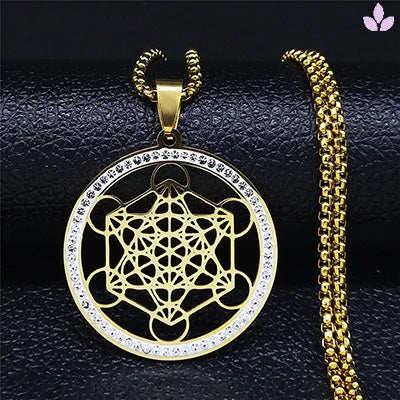
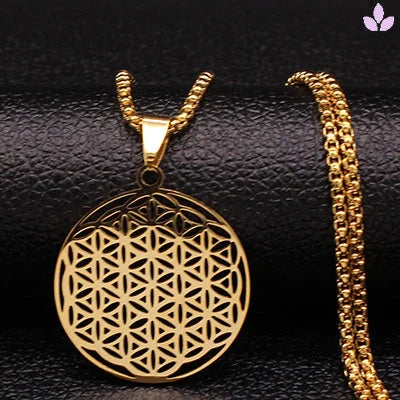
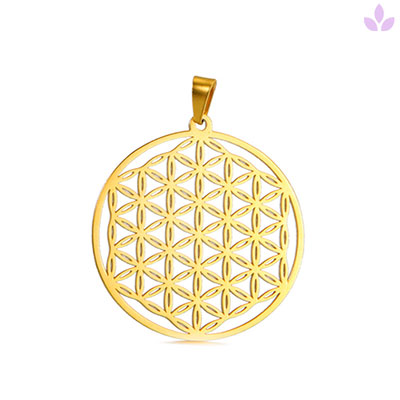
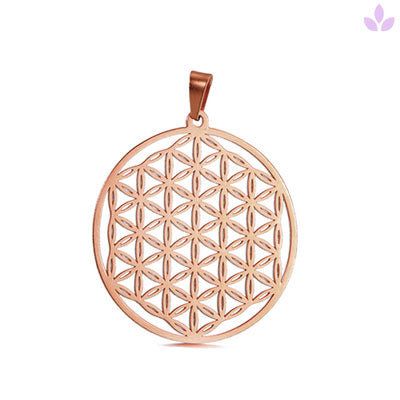
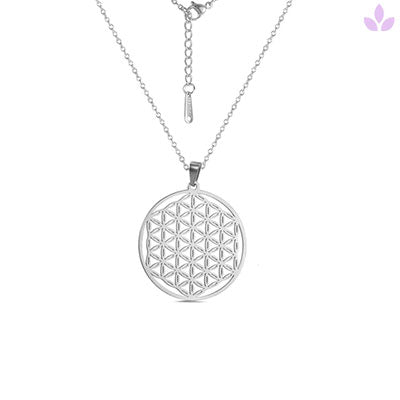
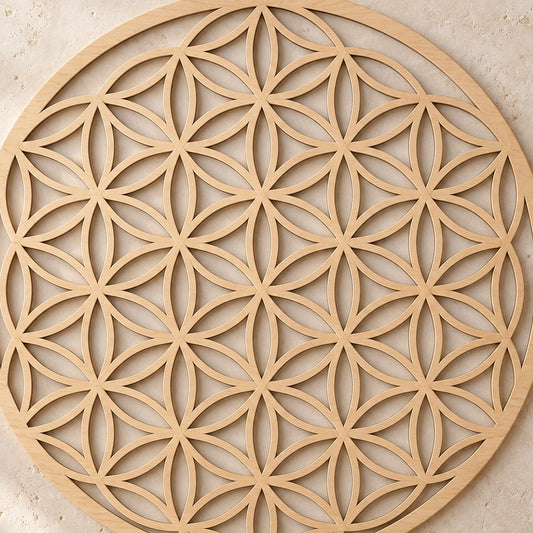
The collection of Fleur de vie necklaces offers geometric patterns that some associate with bonds and continuity. This choice can have an intimate significance, without making the jewelry a proof or an amplifier of synchronicities.
The Fleur de vie Femme Divinité necklace, presented below, is a possibility if this design pleases you. It is not necessary to understand a coincidence and does not allow you to provoke a meeting or a message.

FAQ – Frequently asked questions about synchronicity
Is a synchronicity necessarily a message from the universe?
No. It is a possible spiritual interpretation for some people, not a conclusion proven by coincidence. You can also see it as a fortuitous event that takes meaning in your story.
What is the difference with a simple coincidence?
The word synchronicity emphasizes the felt connection of meaning. It does not provide, on its own, proof that the events were organized or that they announce something.
Can you provoke a synchronicity with an object?
No object is necessary to explore a coincidence. A piece of jewelry or a decoration can serve as a personal reminder, without a guarantee of making signs appear.
Does a synchronicity prove that a person is thinking of me?
No. A correspondence of a first name, date, or situation does not allow you to know the thoughts of others. Only a real exchange can help you understand their intentions.
What should I do if I no longer notice synchronicities?
Nothing in particular. Their absence is neither a failure nor a bad omen. You can continue your activities and commitments without waiting for external confirmation.
Giving meaning without abandoning discernment
The meaning of synchronicities plays out in the meeting between an event and the experience of the person who notices it. You can keep the emotion, the curiosity, or the idea it gives birth to, without turning this personal meaning into a certainty about the future. A fruitful reading opens questions and leaves you free in your answers.