How to calculate your life path number in numerology?
You want to calculate your life path number, but two websites don't always give you the same result? The difficulty often lies less in the addition than in the convention used to reduce the numbers. Explaining this convention is essential before interpreting the result.
Here is a step-by-step method, a fully detailed example, and the points to check in a calculator. Numerology is approached here as a symbolic practice: a number obtained from a date is neither a scientific measure of personality nor a destiny to follow.
What is the life path number in numerology?
The life path number in numerology is a number established from the date of birth according to a rule of addition and reduction. Practitioners then attribute a symbolic reading to it. The calculation and this interpretation are two different operations: checking an addition does not validate the portrait associated with it.
The word "path" can be understood as an image to explore your experiences, not as an imposed road. You do not have to see yourself in a description, choose a profession, or build a relationship based on this result.
This guide focuses on the calculation method. It does not provide a catalog of personalities by number: it is better to first know how a result was obtained than to immediately attribute predictive value to it.
Which date to use and what information is needed?
For the method presented here, only the date of birth is necessary: day, month, and full year. The name, first name, time of birth, and place are not part of this operation. If a tool asks for them, it may offer another study; this information is not essential to reproduce this calculation.
Write the date in day/month/year format to avoid confusion with formats that start with the month. A zero placed before a day or month does not change the sum: 03 and 3 give the same contribution.
Use a real and complete date for your own calculation. To learn without sharing personal data, a sample date is sufficient. You can perform all operations on paper: no account or paid service is necessary.
The reduction rule adopted in this article
We use a numerological reduction by components: we treat the day, month, and year separately, then add the three results. At each step, we add the digits of a multi-digit number until we obtain a single digit from 1 to 9, or a number that the chosen convention retains.
In the convention applied here, we retain 11, 22, and 33 when they appear as the result of a component or the final total. These numbers are often called master numbers in certain approaches. Other methods treat them differently: the important thing is to specify it, then not to change the rule during the calculation.
Retaining a number does not mean it is superior to the others. The vocabulary of "master" belongs to this symbolic practice; it confers no rank, no proven gift, nor any particular obligation on a person.
Detailed calculation: example of March 14, 1990
Let's take the fictitious example date of 14/03/1990. It allows you to see the successive reductions without assuming any personal meaning. Keep the day, month, and year on three separate lines to limit mistakes.
Step 1: reduce the day
The day is 14. We add its digits: 1 + 4 = 5. The result has only one digit: we retain it. The day's contribution is therefore 5.
Step 2: reduce the month
The month of March is written 03. We get 0 + 3 = 3. The month's contribution is therefore 3. You should not use the number of letters in the name of the month: that would be another operation.
Step 3: reduce the full year
For 1990, we calculate 1 + 9 + 9 + 0 = 19. We continue with 1 + 9 = 10, then 1 + 0 = 1. The year's contribution is therefore 1. Forgetting the first two digits of the year would change the calculation.
Step 4: add the three contributions
We bring together the results: 5 + 3 + 1 = 9. The life path number obtained for this example, with the announced convention, is 9. There is no further reduction to perform.

At this stage, the result is arithmetic. A symbolic interpretation of 9 would be an additional reading, not a proven property of this date or the person who carries it.
Why can two calculators display 11 and 2?
Another method consists of directly adding all the digits of the date, then reducing the total. It may match the component method for some examples, but show a master number differently. It is therefore not a reliable comparison if the retention rules are not the same.
Here is a second example, 17/03/1989, chosen to make this difference visible:
| Announced method | Calculation | Result according to the rule |
|---|---|---|
| Separate components | 17 → 8; 03 → 3; 1989 → 27 → 9; then 8 + 3 + 9 = 20 | 20 → 2 |
| Direct sum with final retention of 11 | 1 + 7 + 0 + 3 + 1 + 9 + 8 + 9 = 38; then 3 + 8 = 11 | 11 retained |
The difference between numerological methods lies here in the moment where we stop. If we also reduce 11, we get 2. Before concluding that a tool is wrong, therefore look for its calculation details and its master number retention policy.
The goal is not to select the result that seems the most flattering. Choose an understandable convention, keep the steps, and interpret the number within this framework only.
How to handle 11, 22, and 33 without mixing the rules?
The master numbers 11, 22, and 33 require special attention because some tools retain them at several steps, others only at the final result. To reproduce an author's calculation, you must follow their exact rule, not just their last line.
For example, if the day is 22, this article's convention keeps it as the day's contribution. This does not mean that the final total will necessarily be 22: the month and year must still be processed and added.
In the same way, encountering 11 in an intermediate step does not allow you to state that a person has a life path 11. You must complete the operation. A mirror hour, a street number, or a preference for a number does not replace this calculation based on the date.
The easiest errors to avoid
A verification of the numerological calculation begins with the copied date. Check the order of the day and month, the four-digit year, and each addition. A small error at the beginning can be masked by several correctly performed reductions later.
- Do not confuse the day of birth with the complete life path result.
- Do not replace the birth year with the current year.
- Do not skip a reduction without explaining why you retain the obtained number.
- Do not compare two results without comparing their steps and their rules.
You can redo the additions a second time in a different order to check their accuracy, while keeping the announced method for reduction. The result should not change when you reproduce exactly the same operations.
What to do with the result without making it a label?
A symbolic reading of the life path can open a reflection, but it does not summarize a person. If a description speaks to you, ask yourself what concrete experiences you associate with it. If it does not fit you, you do not have to force your story to make it true.
Do not deduce romantic compatibility, professional aptitude, or an important decision from this number alone. Your context, your desires, your skills, and exchanges with the people involved offer information that cannot be reduced to a date.
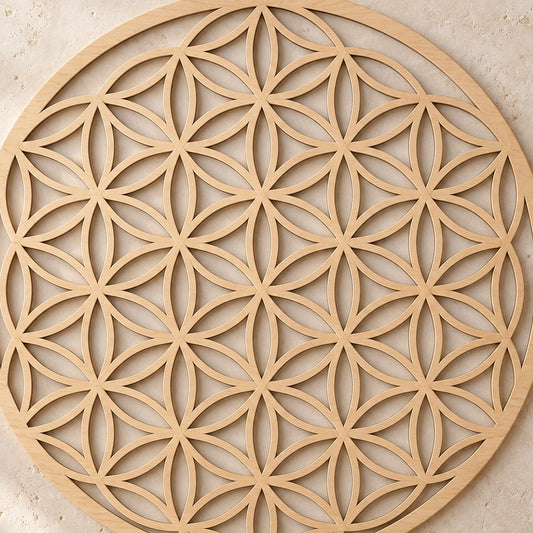
You may also prefer visual language. The collection dedicated to the Flower of Life symbol explores another way of representing repetition and connections through geometry. This connection remains personal: there is no proven correspondence here between a pattern and your numerological result.
The Harmonizing Wooden Flower of Life can be chosen for its decorative presence, without being necessary for the calculation or its interpretation. No object is required to perform the additions on paper.

FAQ – Frequently Asked Questions about Calculating the Life Path Number
Can you calculate your life path number without knowing your time of birth?
Yes. The explained method uses only the day, month, and year of birth. The time is not part of these operations.
Does my result change every year?
No, not with this method, since it is based on a fixed date of birth. Practices that speak of a personal year perform a different calculation and should not be confused with this one.
Should I reduce 11, 22, and 33?
In the convention applied here, they are retained when they appear in a component or the final total. Other methods differ; always check the announced rule before comparing.
Why does my calculator give a different number?
First check the date and the additions, then the order of the reductions and the retention of master numbers. Two methods can present the same reduced result differently.
Does a life path number allow me to know my future?
No. It is a symbolic numerological reading, not a proven method of prediction. The result does not fix your choices or the events to come.
A transparent calculation, a free interpretation
To calculate your life path number, the most useful thing is to keep the date, the convention, and the steps: you will thus be able to check the result and understand a difference between tools. The rigor of addition does not require you to adopt a belief. You remain free to give a place to this symbol, or not to use it.