Spiritual awakening: meaning, questions, and everyday guidance
The term spiritual awakening may come up when you question your priorities, your place in the world, or the meaning you want to give your life. For some, it suggests a sense of openness; for others, it is a term that is too broad or laden with promises. How can you explore it without getting lost in labels?
This guide offers points of reference to help you understand this term, welcome the questions it raises, and choose an approach at your own pace. It does not seek to confirm a spiritual status or interpret physical sensations as evidence of transformation.
What does the term spiritual awakening mean?
In personal use, awakening to spirituality may refer to a greater interest in questions of meaning, connections with others, or how you inhabit your daily life. The word “awakening” thus suggests a change in perspective, not necessarily a spectacular event.
There is no universal framework here that can declare one person “awakened” and another not. The term encompasses different experiences and beliefs. It is not a diagnosis, a diploma, or proof of superiority.
You can explore these questions without adopting this vocabulary. Reading, a conversation, a creative activity, or a moment of silence can nurture reflection without becoming mandatory steps in a journey.
Search for meaning, belief, and practice: three distinct things
A search for meaning involves asking what matters and how to guide your choices. A belief offers an interpretation of the world. A practice is a concrete activity: writing, contemplating a landscape, meditating, or taking time for reflection.
These dimensions can come together, but they do not automatically imply one another. You can enjoy a practice without accepting all the explanations offered around it. You can also hold a spiritual conviction without following a particular routine.
Distinguishing them allows for flexibility. If an activity no longer suits you, you can stop doing it without giving up your questions. If an explanation does not convince you, you do not have to repeat it to be recognized as a spiritual person.
What questions may accompany this approach?
A spiritual journey can begin with very ordinary questions. Do my habits still reflect my values? What place do I want to give to relationships, creativity, or sharing? What allows me to feel present in my life?
These questions do not prove an awakening. They can simply offer space for reflection. Rather than looking for a checklist of signs, you can look at what has truly changed in your desires, choices, or way of listening to others.
For example, wanting greater simplicity can lead to lightening your schedule, not necessarily transforming your entire life. Change can remain subtle, imperfect, and gradual. It does not need to be staged to have value.
Do not turn every emotion into a sign
An intense emotion, a dream, or a coincidence can affect you. You can give it a place in your story without treating it as external validation. It remains useful to distinguish what happened, what you felt, and the explanation you choose to explore.
This distinction protects your freedom: you can change your interpretation, not know, or draw no conclusions. Sincere questioning does not require an immediate answer to every experience.
How to move forward without following an imposed program?
A personal spiritual practice can begin with a single optional activity, chosen for its own sake. The goal is not to accumulate rituals or produce a special experience. Instead, look for what simply fits into your life.
- Read a few pages of a text that raises a question, then note your own reaction.
- Write down what matters to you, without looking for perfect wording.
- Observe a familiar place with greater attention, if you wish.
- Talk with a respectful person who accepts your disagreements.
None of these suggestions is essential. You can try one, modify it, or not continue. The freedom not to practice is one of the points of reference to keep.
A simple example: walking and observing without looking for a message
A quiet walk can be an opportunity to notice the details of a place: colors, textures, sounds, or changes in light. This attention to daily life does not need to become a demanding exercise or a technique designed to induce a particular state.

If an idea appears, you can hold onto it. If nothing special happens, the walk is not a failure. You do not have to receive an answer, spot a symbol, or compare this experience to that of another person.
This approach leaves room for curiosity without organizing the day around external validation. You then return to your activities, with or without a new interpretation.
Meditation and inner life: remaining free to try or stop
Meditation and spirituality can come together for some people, but they are not equivalent. Meditating is not a requirement for exploring questions of meaning, and an unpleasant experience is not necessarily a step you must go through to progress.
If you choose a practice, find out what is being offered and keep the option to stop. Some people report negative experiences during meditation: presenting it as necessarily risk-free would be excessive.
A spiritual practice should not replace medical care or delay a consultation for a health problem. If an experience worries you or disrupts your daily life, seek appropriate advice rather than relying solely on a spiritual interpretation. The label of awakening does not explain what you are going through on its own.
How to choose your reading and support?
Respectful spiritual support leaves room for questions, boundaries, and disagreement. It explains what it offers, acknowledges what it cannot establish, and does not require you to entrust it with all your decisions.
Before following a proposal, ask yourself what is actually being promised to you. Is it a space for exchange, teaching about a belief, or an announcement presented as certain? These offers should not be confused.
| Question to ask | Useful point of reference |
|---|---|
| Can I refuse or stop? | Your choice must remain possible without threats or guilt-tripping. |
| Are the boundaries explained? | A belief should not be presented as proof or a diagnosis. |
| Do I have to buy something to progress? | A purchase is not a universal condition of spiritual life. |
| Can I keep my other connections and opinions? | The approach should not require you to give up your external points of reference. |
Pressure to act urgently, a promise of exceptional power, or a demand for complete obedience are reasons to step back. You do not have to prove your trust by giving up your discernment.
The symbol as a chosen reminder, not an imposed power
A symbol of spirituality can represent a value or intention you choose. Its meaning depends on your interpretation; it does not confer a level of awakening or prove that a transformation is underway.
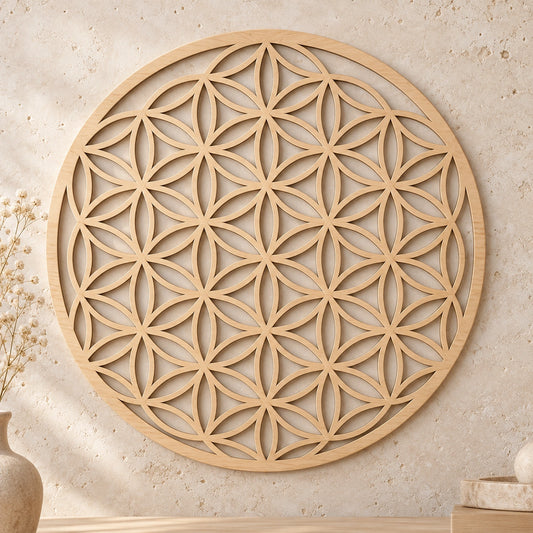
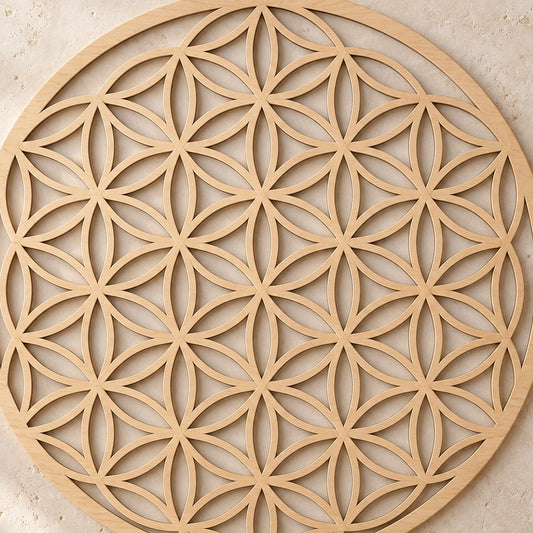
The Wooden Flower of Life collection offers geometric patterns for decoration. Their repetition may please you visually or evoke connections, without the need to associate them with a supernatural property.
The Harmonizing Wooden Flower of Life, presented below, can thus accompany a reading or pause area if you like this design. It remains optional and is not a necessary tool for inducing a spiritual awakening.

Respecting your pace and connections
An inner evolution does not require you to cut yourself off from people who use different words or beliefs. You can explain what interests you without asking others to share your interpretation.
Maintaining ordinary activities, conversations, and commitments also helps prevent you from reducing your entire identity to a spiritual search. A change in perspective can coexist with daily responsibilities and simple pleasures.
You can revisit an idea, slow down, or no longer recognize yourself in a practice. Changing is not a failure of the journey. No framework should prevent you from re-evaluating what suits you.
FAQ – Frequently Asked Questions About Spiritual Awakening
How do I know if I am experiencing a spiritual awakening?
There is no universal test here that can confirm it. You can describe your questions and changes in perspective without needing to give them a specific status.
Do I have to experience something spectacular?
No. A search for meaning can remain subtle and gradual. An intense event is neither a necessary condition nor sufficient proof of awakening.
Should I meditate every day?
No. Meditation is a possible practice, not a requirement. You can prefer reading, writing, walking, or talking, and keep the freedom to stop an activity that does not suit you.
Can an object induce a spiritual awakening?
No object is necessary. A decoration or piece of jewelry can represent a personal intention, without any guarantee of inducing an experience or inner change.
Should I interpret discomfort as a spiritual sign?
No. A spiritual interpretation should not replace appropriate medical advice. If an experience worries you or disrupts your daily life, seek appropriate support without limiting yourself to this explanation.
A search for meaning that leaves you free
The meaning of spiritual awakening can be an openness to the questions that matter to you. You can explore this path without seeking a status, collecting evidence, or following an imposed method. A useful approach leaves room for nuance, daily life, and your freedom to choose.