Spiritual guidance: meaning, limits, and freedom of choice
The spiritual guidance can be appealing when you are looking to clarify a question or make sense of a period in your life. Yet, the term encompasses very different approaches: personal reflection, conversation, symbolic interpretation, or a message presented as coming from an outside source.
How can you understand what is being offered and retain control over your choices? This guide helps you distinguish between different approaches, prepare a useful question, and recognize the limits of support. One perspective may open up a new way of looking at things; it does not become a truth simply because it is presented as spiritual.
What does spiritual guidance mean?
In everyday use, the word guidance suggests direction or insight. Associated with spirituality, it can refer to reflection on meaning, values, or beliefs. It guarantees neither a single method nor a proven ability to know the future.
One person may use the term to describe a conversation that helps them clarify their thoughts. Another may speak of intuition or messages they attribute to a spiritual presence. These uses are not equivalent and should be explained before you begin.
The first useful question is therefore: “What exactly do you do during this support?” A clear answer helps you distinguish the activity being offered from the interpretation given to it.
Intuition, symbols, and predictions: do not confuse different approaches
A personal intuition is an impression you can choose to explore. It is not, on its own, proof. A symbol is something you associate with a meaning. A prediction states that an event will happen: it involves a different level of certainty.
| Approach | Possible wording | Key point to remember |
|---|---|---|
| Impression | This possibility appeals to me. | I can clarify what appeals to me and check the information. |
| Symbolic interpretation | This image suggests a transition to me. | The meaning remains interpretive and may differ for others. |
| Prediction | This event will definitely happen. | A certain assertion does not become proven because it is spiritual. |
Support can be useful if it helps you clarify a question or a value. This does not prove that the person knows your thoughts, your future, or the intentions of your loved ones. You can appreciate a conversation while maintaining this distinction.
What question should you ask to retain your freedom of choice?
A guidance question is often best phrased as an open question focused on what you can explore. “What do I want to clarify in this situation?” leaves more room for reflection than “What decision is the universe imposing on me?”
You can start by describing the situation without interpretation: what is known, what remains uncertain, and what you would like to understand. Then clarify what you are looking for: a space to talk, a symbolic interpretation, or help organizing your thoughts.
Avoid asking someone else to determine the hidden feelings of a third person. An interpretation does not give access to their thoughts. If the question concerns a relationship, dialogue and observable behaviors remain essential.
An example of reframing
Instead of asking “Should I definitely change direction?”, try: “What appeals to me about this possibility, and what still needs to be checked?” Reframing does not provide the answer, but it helps you distinguish between desire, facts, and uncertainties.
You can also choose not to continue. An important question does not necessarily require a spiritual interpretation; sometimes it can become clearer with time, a conversation, or a search for information.
The role of the guide: to offer suggestions, not to decide for you
Respectful spiritual support can offer listening or a perspective within a clearly defined framework. It should not require you to give up your other sources of information or your right to decline.
Ask what the person can offer and what they cannot establish. Personal experience, belief, or training does not automatically enable them to answer all the questions in your life.
Your role is not to prove your trust by accepting every interpretation. You can ask for clarification, express disagreement, or set a suggestion aside for now. A response that does not resonate with you is not necessarily a sign of an internal block.
Explore several possibilities without looking for the perfect answer
Spiritual reflection can open up several interpretations of the same situation. The goal is not necessarily to immediately select the right one, but to see what each one invites you to consider and what it leaves out.

Imagine you are hesitating about starting an activity. One interpretation may emphasize novelty; another, the need to preserve time. You do not have to treat them as contradictory messages that need to be resolved by a new sign.
Instead, look at what you can check: the content of the activity, your availability, your genuine desire, or the possibility of trying it. The symbol accompanies your reflection; concrete information gives it a practical basis.
What questions should you ask before a session?
Before committing to a spiritual guidance session, ask for a clear framework. The process, duration, price, and any proposed follow-up should be clear enough for you to choose without pressure.
- What exactly happens during the session?
- Are interpretations presented as beliefs or as certainties?
- Can I decline a proposal or end the conversation?
- Is follow-up or an additional purchase expected?
- Can I take my time and seek other opinions?
These questions are not intended to judge a belief. They help you understand an offer and retain your ability to decide. You can also conclude that this approach is not what you are looking for.
Pressure, isolation, and urgency: when to step back?
Spiritual discernment remains important when faced with a demand for obedience, financial pressure, or an invitation to break with all your external points of reference. These situations warrant stepping back and seeking an independent opinion.
A promise such as “You must act immediately to avoid misfortune” does not provide proof. Similarly, refusing to allow any questions or suggesting that only one person could understand you can limit your freedom of judgment.
An isolated clue cannot, on its own, characterize a situation as problematic. The practical issue is not to remain alone when facing pressure, to maintain your connections, and not to let a spiritual interpretation replace support appropriate to a concrete problem.
Guidance should not replace medical care or lead you to stop a treatment. Health questions require an appropriate professional opinion, not a spiritual explanation presented as sufficient.
Can you explore guidance without consulting someone?
A personal spiritual approach can remain independent. You can read a text, write down a question, or look at an image that inspires you, without attributing to the medium the power to provide you with a certain answer.
A simple exercise is to separate three lines: “what I know,” “what I feel,” and “what I want to check.” Then add a small, practical action if it seems useful. This method organizes your reflection without predicting the future.
There is no need to keep trying until you get the desired answer. You can leave a question open, return to it later, or decide to seek information outside of spirituality. The right not to know is part of the freedom to interpret.
The role of an object: a reminder, not an authority
A symbolic medium can remind you of a value or intention. Its role depends on your choice; it does not validate a decision or measure the accuracy of guidance.
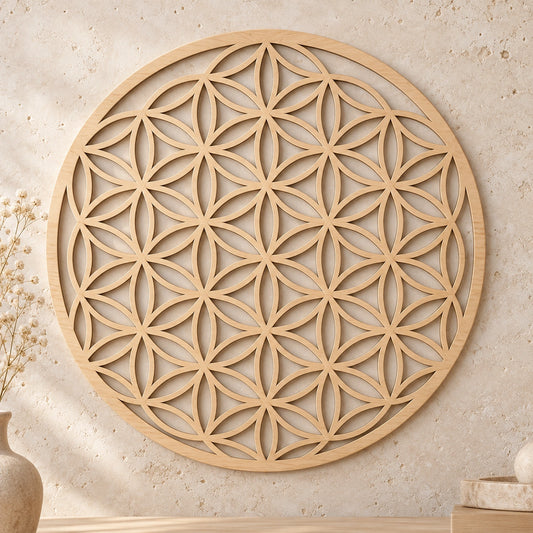
The collection dedicated to the Flower of Life symbol offers objects based on a geometric pattern. You can appreciate the design or the personal meaning you give it without seeing it as a proven source of messages.
The Harmonizing Wooden Flower of Life, presented below, can accompany a space for reflection or rest if you like it. It remains an optional decoration, not an object necessary to obtain an answer or receive guidance.

FAQ – Frequently Asked Questions About Spiritual Guidance
Does spiritual guidance always predict the future?
No. The term covers a variety of approaches. Symbolic interpretation or conversation does not constitute a proven method of prediction.
Should I follow an interpretation that does not resonate with me?
No. You can question it, set it aside, or leave it for later. Disagreement is not proof of a spiritual block.
Can you learn what a loved one is thinking through guidance?
An interpretation cannot establish another person’s thoughts or intentions. Real conversations and observable behaviors remain necessary.
Should a session always be followed by additional purchases?
No. You should be able to understand what is being offered and choose without pressure. An object or follow-up does not become necessary because it is given a spiritual function.
Can you stop a spiritual approach?
Yes. You can change your mind, step back, or choose a different way of thinking. A respectful approach leaves room for refusal and for your other connections.
A perspective that leaves the decision to you
The meaning of spiritual guidance can be that of a chosen insight, a better-phrased question, or a symbolic interpretation. Its value does not require you to give up your judgment. Retain the possibility to check, to take your time, and to decide with the information that matters to your situation.