Bhavachakra: The Meaning of the Wheel of Life in Buddhism
The bhavachakra, or Buddhist wheel of life, represents the cycle of existence, known as samsara. In many Tibetan paintings, it is recognizable as a wheel divided into rings and sections, held by a fearsome figure. The design explains how the cycle continues and also indicates the possibility of escaping it.
To read the wheel, start at the center and move toward the edge. The hub reveals the causes, the large sections show realms of existence, and the border unfolds a series of scenes. A final clue is sometimes found outside the circle.
What do the three animals in the center mean?
The pig represents ignorance, the snake anger or hatred, and the rooster desire or attachment. These three animals represent the three poisons that sustain the cycle. They may appear to be chasing each other, giving a visible form to the way these dispositions reinforce one another.
In everyday life, this dynamic can be recognized when we cling to an idea and react with anger to anything that contradicts it. The central motif invites us to look at what fuels a reaction. It thus provides an initial key before the many figures in the following rings.

How to read the six realms of the wheel of life?
The large sections generally depict six realms of existence. They include the gods, demi-gods, humans, animals, hungry ghosts, and hell realms. Depending on the image, gods and demi-gods may share a zone. The painting at the Rubin Museum attributed to Lhadripa Rinzing Chungyalpa allows us to observe this organization.
In tradition, these realms belong to the cycle of rebirth. They are also read as images of familiar dispositions, such as envy or dissatisfaction. The two readings help us understand why each section shows a scene with its inhabitants and their activities.
What do the twelve scenes on the border tell us?
The border illustrates the twelve links of conditioned co-arising. They show how one state arises in relation to other conditions. Each link may be depicted by a small scene. A blind person may represent ignorance. A potter shaping a vessel may evoke the formations that guide the continuation of the cycle.
To follow this ring, look for the detail that recurs in the legends of a guide, then trace it from scene to scene. Painted versions do not all present the same level of detail. In a small reproduction, the sequence of images may be easier to see than each individual figure.
Who holds the wheel, and why look outside the circle?
The figure holding the wheel is often identified as Yama, the lord of death. Their gesture provides an image of impermanence that affects the different realms. Outside the wheel, a Buddha may point to the moon. This detail indicates a path to liberation. Therefore, also look at the upper corners of the painting, where the answer to the cycle represented in the center is sometimes found.
Wheel of life and wheel of Dharma, two compositions
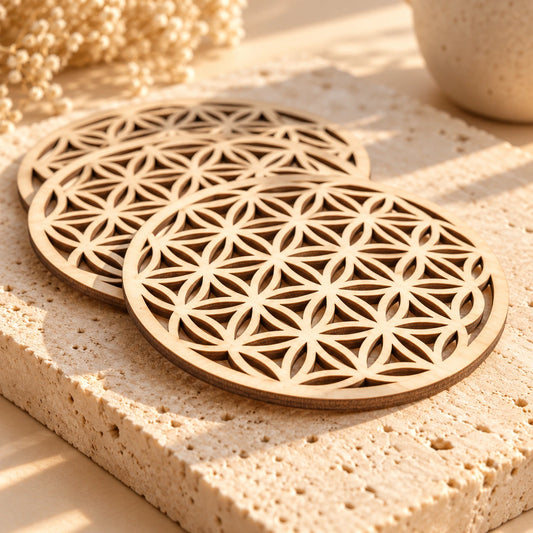
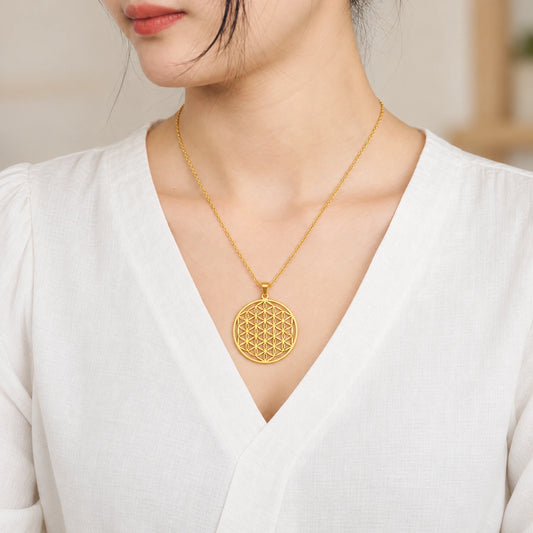
The Buddhist wheel of life is recognizable by its scenes in rings and the figure holding the circle. The wheel of Dharma is often a spoked emblem that refers to the transmission of teachings. To extend this gaze at round motifs into a meditation space, the wall-mounted Flower of Life below highlights the repetition of openwork arches. Find other designs in the Wooden Flower of Life collection.

Between the center and the large sections, some paintings add a light crown and a dark crown where figures ascend or descend. They link the three dispositions in the center with the situations found in the realms that surround them.
FAQ – Frequently asked questions about the bhavachakra
Where to begin reading the wheel?
Start with the three animals in the hub. Then look at the sections, then the small scenes on the border, and finally the figures placed outside.
What does the outer circle mean?
It represents the sequence of twelve conditions linked to the cycle of existence. Each scene provides an image of one link.
Does the wheel show an escape from samsara?
Yes. In some depictions, the Buddha points to the moon outside the wheel, an image of the possibility of liberation.
In summary
The bhavachakra presents the cycle of existence in several rings. The center shows its causes, the border unfolds its conditions, and looking outside the wheel opens up another perspective.