Ensō Circle: Meaning of the Zen Circle and the Brushstroke
The ensō circle is a circle drawn with a brush and ink, associated with the Japanese Zen tradition. It can evoke awakening, presence, and the way a gesture unfolds in the moment. The line retains variations in pressure, areas where the paper shows through, and the end of the movement.
An opening is sometimes visible where the brush was lifted. To understand the drawing, look at both the quality of the line and the outline it forms. Some artists add an inscription that further changes the way the circle is interpreted.
What does Ensō mean in Japanese?
The word ensō refers to a circular shape. In ink painting associated with Zen, the circle is commonly created in a continuous movement. The artist may leave it alone or accompany it with an inscription. The emptiness at the center, the quality of the ink, and the space of the paper all contribute to the drawing.
The Zen circle can be read as an image of awakening or as the trace of a presence at the moment of painting. The brush, paper, and amount of ink leave concrete clues. They allow you to look at the artwork even before knowing the interpretations of the motif.

How to read the movement in an Ensō?
Start with the part most heavily laden with ink. Then look to see if the line thins or splits into very fine lines. These differences can come from pressure, the speed of the gesture, and the amount of ink available. In some places, the fibers of the paper remain visible. Elsewhere, the ink covers almost the entire surface.
A brushstroke can have a very expansive form even if it fits on a modest-sized sheet. The empty space around it helps you perceive this expansiveness. When viewing a circle in a museum, look at it first as a whole, then bring your gaze closer to the edge to rediscover the marks of the gesture.
Open or closed Ensō: what changes?
In an open circle, a gap separates the beginning and the end of the line. This transition can evoke openness or the acceptance of that which remains unfinished. In a closed circle, the two ends meet. The outline can then suggest wholeness or continuity. These interpretations depend on the artwork and the intention attributed to the artist.
Also compare the place where the line breaks. A small opening in very dry ink gives a different impression than a wide space between two clean ends. This observation allows you to nuance an interpretation based solely on the presence or absence of emptiness.
Sengai Gibon's circle and the invitation to take tea
The Fukuoka Art Museum preserves a circle painted by Sengai Gibon, a Japanese Zen monk. The inscription invites you to eat what is depicted and to take tea. The bottom of the circle is wide enough to evoke a small cake. The juxtaposition of a figure of awakening and a familiar object gives the artwork a humorous dimension.
This example shows why it is useful to also look at the words that accompany the circle. An inscription can shift the interpretation, introduce a joke, or invite you to recognize something in a very simple form.
Ensō circle and Flower of Life: two uses of the circle
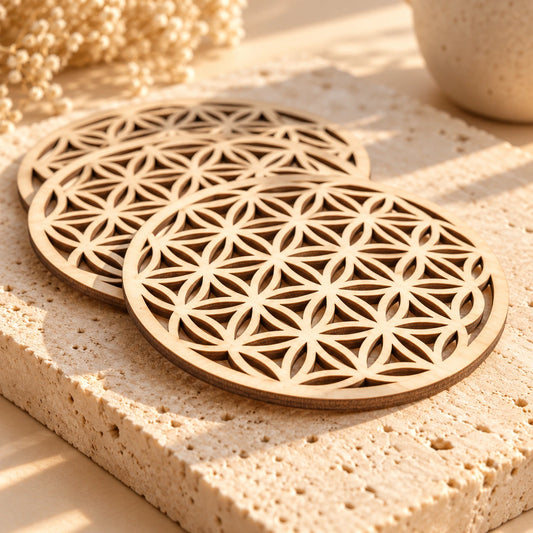
The Ensō highlights the trace of a gesture. The Flower of Life repeats circles of the same size that intersect and form petals. In a meditation space, these two compositions provide different points of focus. The Plenitude Flower of Life below makes the repetition of the arcs visible thanks to the openwork wood. Other motifs can be found in the Wooden Flower of Life collection.

FAQ – Frequently Asked Questions about the Ensō Circle
Must an Ensō be perfectly round?
Regularity varies depending on the hand, speed, and pressure of the brush. Variations in curve and thickness are part of the drawing.
Can you draw the circle yourself?
To observe the gesture, take a brush, some ink, and paper. Draw a circle in one movement, then look at the variations before starting again on another sheet.
Is an Ensō a mandala?
An Ensō generally focuses on a circle created with a brush. A mandala often features a more detailed organization around a center, depending on the use and tradition.
In summary
The ensō circle finds its meaning in the movement that left it on the paper. To read it, observe the ink, the ends of the line, and, when present, the inscription.