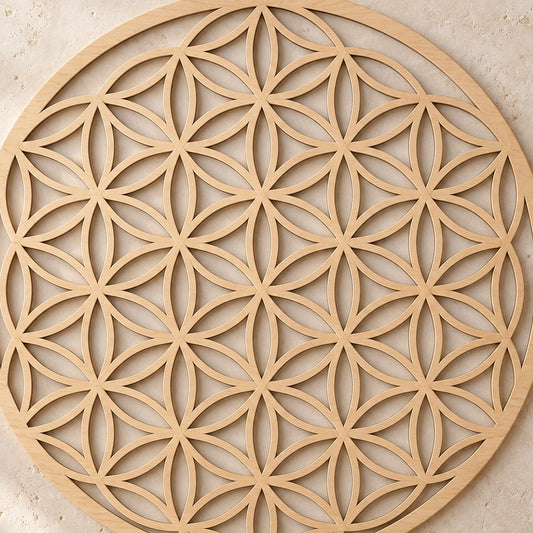
How to compare the dimensions of a Flower of Life?
Understanding the dimensions of a Flower of Life requires distinguishing several pieces of information: the outer diameter, the space it occupies, the scale of the photograph, and the characteristics of the support. A number of centimeters is not enough to describe the weight or how it will look in a room.
This method helps you read the measurements and create a template. The 20, 30, and 40 cm Harmonisante sizes serve as calculation examples, not as a commercial classification or automatic recommendation for your home.
Identify what the measurement describes
Start by looking at the label accompanying the number. A measurement may indicate a width, height, thickness, or diameter. This information is not interchangeable, even when a visual shows an object that appears circular.
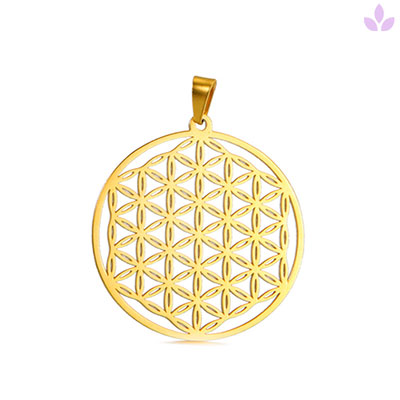
The diameter of the Flower of Life corresponds to the distance between two opposite points on the outer edge, passing through the center. If the piece is perfectly circular, it describes both its maximum width and maximum height.
A mention of “20 × 20 cm” may describe a square footprint around a motif. It does not prove on its own that the piece is a solid disc. Check the shape and exact indications, especially when the product has an irregular outline or a hanging element.
A photo helps you recognize the design, but the written measurement must remain the reference. If the information is ambiguous, ask what it encompasses before doing your calculations.
Do not confuse diameter and radius
The radius of the circle corresponds to half the diameter. This difference is essential for drawing a template: a 20 cm diameter model requires a 10 cm radius, not 20 cm.
For a 30 cm diameter, the radius is 15 cm; for 40 cm, it is 20 cm. You can write down both values on your paper before starting. This prevents drawing an outline twice as wide as intended.
If you use a compass, the radius sets the distance between the point and the pencil. If you are simply comparing a width on the wall, the diameter is what interests you. The same object therefore calls for two measurements depending on the action you are preparing.
Compare areas without confusing them with the amount of wood
The area of the outer disc helps you understand why a change in diameter significantly alters the footprint. For a circle, it is calculated using the radius: area = π × radius × radius.
| Outer diameter | Radius | Area of the outer disc, approximately | Area ratio compared to 20 cm |
|---|---|---|---|
| 20 cm | 10 cm | 314 cm² | 1 |
| 30 cm | 15 cm | 707 cm² | 2.25 |
| 40 cm | 20 cm | 1,257 cm² | 4 |
The 40 cm diameter is twice that of the 20 cm one, but the area of its outer disc is four times larger. This relationship is geometric. It does not mean that the product contains four times as much material or weighs four times as much.
An openwork Flower of Life contains empty spaces. Its thickness, material, and construction also matter. The area calculated here represents a disc that encompasses the piece, not the solid surface of its lines.
Check the units before comparing two product sheets
A size in centimeters should not be directly compared to a number in millimeters. Convert the indications to the same unit before concluding that two products are different sizes.
For example, 20 cm corresponds to 200 mm. A width of 200 mm and a diameter of 20 cm can therefore refer to the same distance, if the labels accurately describe the same part of the object.
Do not mix up thickness with diameter either. A number of millimeters placed near the material description may refer to the depth of the piece, not its width. The question to ask remains: what is actually being measured?
If a product sheet presents several variants, check the information for the one you have selected. The size shown in an image is not necessarily the active variant at the time of your selection.
Create a full-scale template
A Flower of Life template is used to represent the outer outline without reproducing all the openwork. Prepare a large enough sheet of paper, assembling pieces if necessary, then mark the center of the circle.
Next, choose the radius corresponding to the diameter you are studying. Draw the circle with a suitable tool, then check its maximum width with a ruler or tape measure. This second measurement helps identify a radius error or a misalignment in the drawing.
You can write the diameter on the paper and prepare several templates. It is useful to look at them separately in the same location: the accumulation of three circles can give a different impression than that of a single object.
The paper outline does not reproduce the weight, the shadows, or the details of the wood. It answers a specific question: how much outer space does this size take up here? Keep this limitation in mind when interpreting the test.
Observe the template from your usual viewpoints
The comparison of dimensions becomes more meaningful when you look at the template closely and then from the other side of the room. Also place yourself where you usually sit or work.
There is no mandatory relationship between a motif size and the number of square meters in a room. The available wall space, neighboring objects, and viewing distance are more useful to observe than this floor area alone.
If you temporarily place the paper on a wall, use a method compatible with the surface without damaging it. Another person can also hold it while you step back.

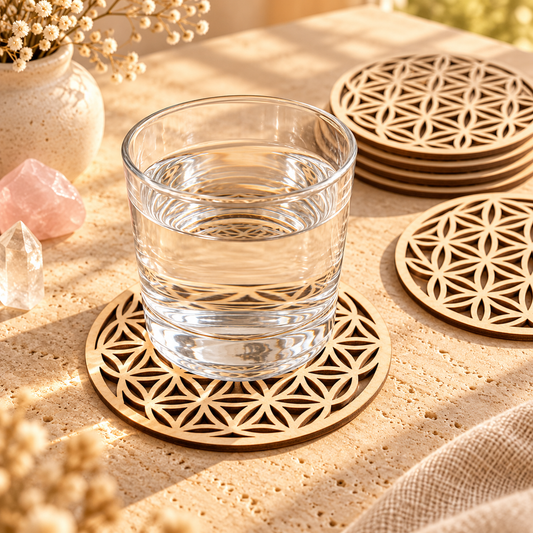
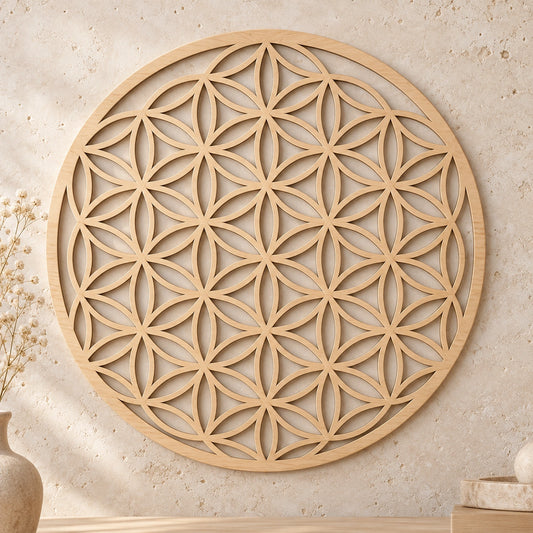
The staging above does not replace this test. It shows a relationship between an openwork motif and its background, but its proportions cannot be automatically transferred to your space.
Understand why an image does not provide a reliable scale
The scale of a photograph depends on the framing, perspective, and known dimensions of the depicted elements. A close-up can make a small piece appear very prominent, while a wide shot visually reduces the motif.
The number of pixels in an image does not directly correspond to a length in centimeters of the object. Without a reliable physical reference, measuring the motif on a screen does not allow you to deduce its actual diameter.
A photo can therefore help you study the lines, color, and context, but not replace the measurements on the product sheet. The staging of this item is illustrative: it does not constitute scaled plans or installation instructions.
Use Harmonisante as an example of variants
The product sheet for the Harmonisante Wooden Flower of Life offers diameters of 20, 30, and 40 cm. These variants allow you to concretely apply the differences in radius, outer area, and footprint explained above.

The name Harmonisante refers to the product. The size of a motif does not demonstrate a level of spiritual power. In this example, the numbers serve to compare a footprint and prepare a location.
To see the models and their own information, you can view the Wooden Flower of Life collection. The method of reading measurements remains useful regardless of a purchase.
What dimensions cannot conclude
The footprint of the motif does not automatically indicate its weight, strength, or hanging system. A width may be known while this information still needs to be requested.
Do not choose a mounting based solely on the diameter, and do not consider the thin parts of the openwork as hanging points. The model's recommendations and the nature of the support must be checked separately.
Measurements also do not summarize the meaning of the design. For this other intention of reading, the guide to the meaning of the Flower of Life deals with the motif itself. Here, we compare values and their visual translation.
FAQ – Frequently Asked Questions about the Dimensions of a Flower of Life
How do I read a diameter of 20 cm?
It describes the outer width of a circle passing through its center. The corresponding radius is 10 cm.
Does a diameter twice as large double the surface area?
No. The area of the outer disc is then multiplied by four. This does not directly give the amount of material in an openwork piece.
Should I draw all the petals on a template?
No. A full-scale circle is enough to compare the footprint. However, it does not reproduce the transparency, shadows, or details of the motif.
Can I measure the actual size from a photo?
Not reliably without a physical reference and without mastering the scale. The measurements indicated for the variant remain the reference.
Is the diameter enough to choose a mounting?
No. Check especially the weight, the design of the product, and the recommendations adapted to the support before planning its installation.
First measure what you want to compare
Identifying the label, harmonizing the units, and checking a template allows you to compare dimensions without letting them say something else. You then have a reference for space, distinct from style, weight, mounting, and symbolic interpretations.