Blue lotus flower: meaning of the Nile water lily in ancient Egypt
The blue lotus flower evokes the Sun, renewal, and regeneration in the art of ancient Egypt. The name refers to the blue water lily of the Nile, an aquatic plant whose pale flower opens in the daylight. The return of the flower provided a concrete image of renewal.
The flower is recognizable by its fine, radiating petals. Its form can be found in objects made in Egypt, even in bowls whose rims resemble a corolla. These objects allow us to move from the observed plant to the motif chosen by the artisans.
Is the Egyptian blue lotus a lotus or a water lily?
The “blue lotus” of ancient Egypt is Nymphaea caerulea, a Nile water lily. Its floating leaves generally have a notch. Its flower forms a star of light blue to purple petals around a yellow center. The sacred lotus of Asia, Nelumbo nucifera, belongs to a different group of plants and is notably recognizable by its large receptacle shaped like a watering can.

This difference helps us interpret the images. In a naturalistic painting, the leaves and the heart of the flower provide several clues. On a bowl or engraving, the artisan may simplify the design. In this case, the date, origin, and type of object provide more information than a single petal detail.
Why does the blue lotus evoke the Sun?
The flower opens in the presence of daylight and then closes. This repeated movement offers a comparison with the daily return of the Sun. In some Egyptian traditions, a flower emerging from the primordial waters also participates in the narrative of the appearance of light. The motif thus associates a visible phenomenon with an image of beginnings.
The symbolism of renewal lies in this return. An open flower can give the impression of an unfolding radiance. A bowl shaped like a half-open flower preserves the image of the moment when the petals begin to spread. The angle chosen by the artisan changes what the eye perceives first.
How to recognize a blue lotus on an Egyptian object?
The Metropolitan Museum of Art preserves a lotus-shaped bowl from the New Kingdom whose silhouette evokes a partially open blue flower. Petals are engraved on its surface. A royal inscription is found on one of them. The object thus incorporates the flower even in its volume, beyond a simple motif added to the decoration.
On a bowl, observe the profile and the arrangement of the petals. In a painting, look at whether the motif grows from the water, appears in a hand, or blends with other plants. The same design can be used to evoke an aquatic environment, give shape to a vessel, or participate in a symbolic scene.
What does the lotus motif retain in a modern piece of jewelry?
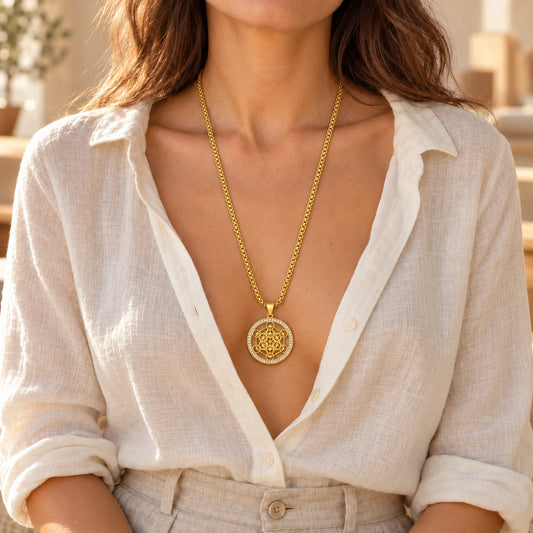
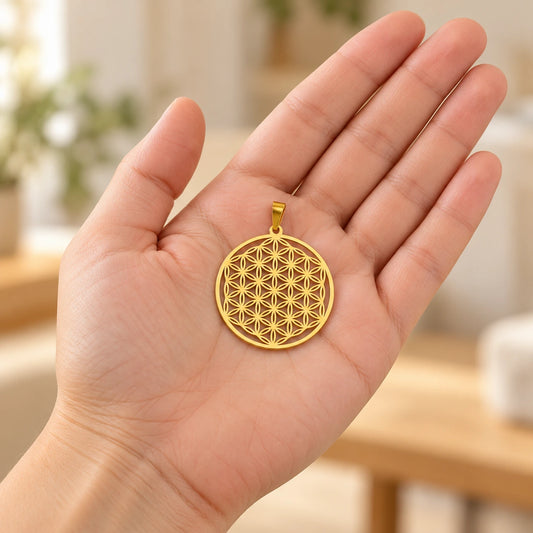
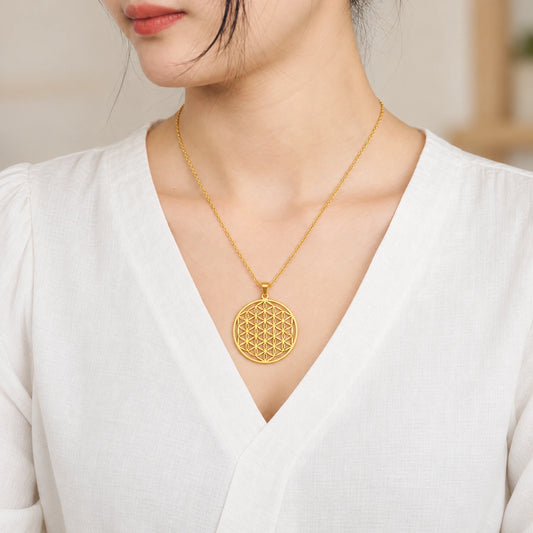
A contemporary pendant can simplify the flower into a few petals opening around an axis. This shape suggests blooming even when the color and botanical details disappear. The necklace presented below offers a lotus silhouette in a rose gold finish. In the collection of jewelry and sacred symbols, you can compare other ways of making an ancient motif legible on a piece of jewelry.

The name “lotus” comes from an ancient usage adopted in art guides. It remains useful for finding objects in museums. To identify the plant, the name blue water lily provides more precision. These two terms allow you to search for both representations and botanical descriptions.
FAQ – Frequently Asked Questions About the Blue Lotus Flower
What is the name of the blue lotus flower of the Nile?
Its scientific name is Nymphaea caerulea. It is commonly called the Egyptian blue lotus or blue water lily.
Why does the blue lotus symbolize rebirth?
Its regular opening in the daylight recalls the return of the Sun. Egyptian art made this flower an image of renewal and reappearing life.
How to distinguish it from the Asian lotus?
The blue water lily has narrow petals and a yellow center. Its floating leaves are notched. The Asian lotus features a clearly visible central receptacle, which becomes a seed pod.
In summary
The blue lotus flower connects an aquatic plant to the idea of the day beginning anew. In Egyptian objects, the curve of the bowl and the arrangement of the petals still allow us to recognize this connection with the real flower.