Octagon: the meaning of the eight sides in sacred geometry
An octagon is a polygon with eight sides and eight angles. In sacred geometry and certain architectural traditions, it evokes a passage, a new order, or an organization around a center. Its shape allows for a visual transition from the four cardinal directions to eight directions and brings the square closer to a circular outline.
To understand the meaning of the octagon, you must look at the design and the context in which it appears. A baptistery plan, a decorative motif, and a figure constructed with a compass highlight different aspects. Here are the landmarks that allow you to read them without losing sight of the eight sides.
How to recognize an octagon?
Follow the outline and count the straight segments. An eight-sided polygon is an octagon, even if its sides have different lengths. It becomes regular when the eight sides and the eight angles are equal. The regular silhouette is often recognized by its horizontal and vertical sides connected by four slanted sections.
To avoid recounting the same side, choose a visible starting point and always move in the same direction. The number of vertices must match the number of sides. A rounded outline may suggest an octagon while making the angles difficult to distinguish. A clearer view of the edge then helps to decide whether it is indeed a polygon.
The rotation of the motif changes its appearance. An octagon resting on one side provides a horizontal base. The same design, turned by a small angle, may present a point at the top. The number of sides remains identical. This variation explains why two octagonal objects can produce a different impression at first glance.
What does the octagon mean in sacred geometry?
A common interpretation sees the octagon in sacred geometry as a transitional form between the square and the circle. The square has four clearly distinct sides. By introducing four additional sections, the octagon multiplies the orientations of the outline and visually brings its silhouette closer to a round shape.
This relationship is notably developed in the traditional readings of René Guénon. The square, the circle, and the octagonal plan participate in a symbolic interpretation of architecture. To understand this proposition, you can start with a simple drawing. Place a square around a circle, then observe the space that remains at the corners. The addition of oblique sections changes the way the eye moves from one shape to another.
The figure can therefore evoke an intermediary or a passage. In a personal interpretation, this idea readily applies to a moment of transformation. A framework is preserved, while giving movement more directions. The meaning here is nourished by a visible relationship between several shapes.
Why associate the octagon with the eight directions?
The four cardinal points can be completed by four intermediate directions. North, east, south, and west then become eight orientations with northeast, southeast, southwest, and northwest. In a regular octagon, eight points regularly distributed around the center offer a simple image of this organization.

If you connect the eight vertices to the center, the full circle is divided into eight equal sectors. Each measures 45 degrees, since 360 ÷ 8 = 45. This result allows you to understand the regularity of the design and the relationship to the directions, without adding meaning to each vertex.
In a decoration, the actual orientation of the building or object must be examined separately. A shape has eight directions in its construction, but a vertex drawn at the top of a page does not automatically indicate north. A plan or notice can specify how the geometry relates to the location.
The octagon and the eighth day in Christian art
The symbolism of the number eight holds a place in Christian baptismal architecture. The Opera di Santa Maria del Fiore explains that the octagonal plan of the Florence baptistery refers to the "eighth day," after the seven days of Creation. This image evokes new life and the eternity promised to the baptized.
The link is read in the function of the place as much as in its form. Baptism marks an entry into a Christian life. An eight-sided space can give an architectural expression to this new stage. We can therefore understand the symbol by linking the number of sides to what happens in the building.
The same reading can be found in the shape of a basin or a baptismal font. The scale changes, but the relationship between the motif and the rite remains perceptible. To read an object of this type, first count the sides, then observe its location and the elements that inform its function.
Three examples to observe the octagonal plan
The Florence Baptistery
The Saint John Baptistery in Florence has eight sides. The design extends to its cover, described by the institution as an eight-section ensemble. It becomes easier to understand when you compare the exterior silhouette to the plan. The eye moves from the facades to an interior organization around a central space.
The Neonian Baptistery in Ravenna
The Ravenna tourist service describes an octagonal basin in the middle of the Neonian Baptistery. This example allows you to observe the shape at the center of the space, as close as possible to the baptismal use. The material, dimensions, and decorations give the basin its presence, while the eight sides draw its outline.
Castel del Monte
Castel del Monte, in southern Italy, gives another use to the octagon. UNESCO highlights the octagonal plan of the castle, the eight towers, and the geometric organization of the whole. The number eight is repeated at several scales. An overall plan allows you to see the relationship between the large outline and the towers placed at its corners.
The comparison between these examples shows the importance of starting from the support. A castle, a baptistery, and a basin share a shape. Their function and context then give the design a different place in the reading of the location.
Octagon and octagram, what is the difference?
The regular octagon features a convex outline with eight sides. The octagram draws an eight-pointed star. If the eye follows lines that cross inside the figure or points that advance outward, you must observe the construction of the star.
A decoration can combine both. The eight points of a star can rest on the vertices of an invisible or explicitly drawn octagon. The number eight makes the link, but the path followed by the line changes. This distinction helps to understand rosettes, pavings, and motifs that superimpose several figures.
| Figure | Outline to observe | Main landmark |
|---|---|---|
| Octagon | Eight successive sides | Eight-angled polygon |
| Octagram | Eight-pointed star | Star-shaped outline |
| Circle | Continuous curved line | Absence of straight sides |
What are the angles of a regular octagon?
It is useful to distinguish two angles. The first is at the center, between two radii that meet neighboring vertices. It measures 45 degrees. The second is at a vertex, between two successive sides of the polygon. This interior angle measures 135 degrees.
To find this last result, imagine that you are walking along the outline. At each vertex, you turn 45 degrees to follow the next side. After eight turns, you have completed a full 360-degree turn. The interior angle and this change of direction are additional. Their sum is 180 degrees, hence 180 − 45 = 135.
You can verify the result by another method. From a vertex, draw diagonals to the non-neighboring vertices. The convex octagon is cut into six triangles. Their angles total six times 180 degrees, or 1,080 degrees. By sharing this total among eight equal angles, you find 135 degrees.
How to draw a regular octagon in a circle?
- Draw a circle and mark its center.
- Draw a horizontal diameter and a vertical diameter. They determine four points on the circle.
- Divide each of the four right angles at the center into two equal angles.
- Extend these four new directions to the circle. You get eight regularly spaced points.
- Connect the neighboring points with a ruler, going around the circle.
This construction uses the eight vertices as landmarks. The segments between neighbors have the same length because they correspond to equal sectors of the circle. Before going over the outline again, check that you have connected consecutive points. Skipping one or more vertices produces another figure.
For a decorative realization, keep the radii in light pencil until the final check. They make the spacing visible and facilitate the comparison of the sectors. You can then erase them if you wish to keep only the octagonal outline.
Can you obtain an octagon by cutting the corners of a square?
Cutting the four corners of a square produces eight sides, but the eight lengths do not become equal by chance. You get an irregular octagon if the cut sections are too small or too large compared to the remaining sides.
Let's take a square with a side of 10 cm. To obtain a regular figure by this process, the distance to mark on each edge from each corner is about 2.93 cm. The straight part that remains in the middle of each edge measures about 4.14 cm. The four new oblique sections have the same length.
These values come from the relationship between the small cut triangle and the preserved side. If the marked distance is called d, the oblique section measures d × √2. The segment remaining on the edge of the square measures 10 − 2d. We equalize them to obtain the eight sides of the same length. This detail explains why a cut simply done "by eye" can give a convincing shape without being regular.
What place does an octagon occupy in a square format?
To imagine the motif on a wall or on a page, compare its maximum width and the length of one side. In a regular octagon resting on a horizontal side, the width is about 2.414 times the length of one side. A side of 4 cm therefore gives a width close to 9.66 cm. The design appears larger than the measurement of a single segment would suggest.
This proportion is useful when you are preparing a frame or a support. Measure the motif from one extreme edge to the other before choosing its location. Then add the white space you wish to keep around it. The outline needs this margin so that the eight sections remain readable, especially if the background already has a decoration.
The same principle applies to a small printed image. At a reduced size, the four oblique sections can become less visible if the line is thick. Make a test in the final format and look at the motif from the distance where it will be used. You can thus adjust the fineness of the outline or the size of the whole.
If you are working with an irregular octagon, these proportions change. Counting the sides is enough to name the figure, but the distribution of space depends on its lengths and its angles. An elongated design will emphasize one direction, while a regular octagon will distribute the eye more evenly around the center.
What can the octagon evoke in a personal decoration?
The figure can accompany an intention of balance, passage, or openness to several directions. To choose a reading, start from what attracts you in its construction. Is it the common center? The repetition of the eight sides? The way the angles soften the presence of a square?
An octagonal frame highlights the outline. A floor motif allows you to follow the directions with your body. A radiating design draws the eye toward the center. The material and the chosen place therefore change the way the symbol is experienced daily.
You can try a small visual exercise. Draw a square, an octagon, and a circle at the same height on a sheet. Look at the transition from one to another without adding any decoration to them. Then write down a few words about the impression produced by each outline. This personal look completes the historical meanings and allows you to understand your choice.
Choosing curves and repetitions for a calm space
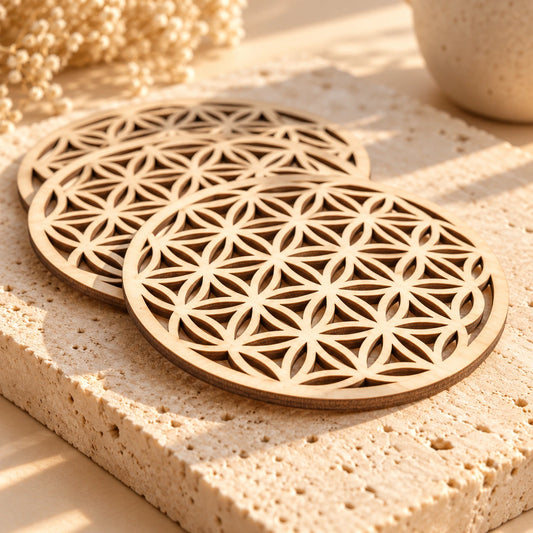
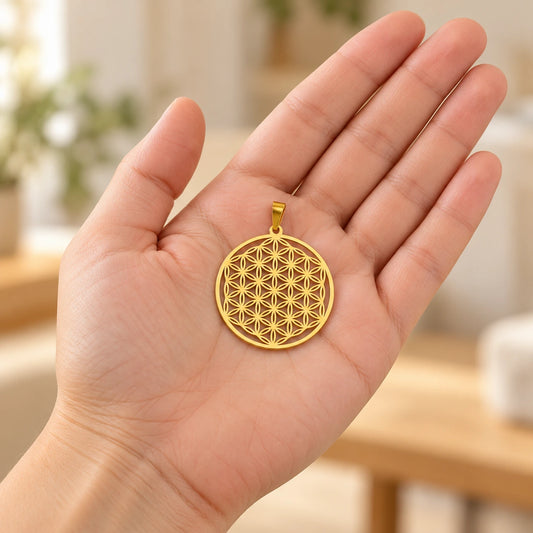
The Flower of Life explores another way of organizing a motif around a center. Circles of the same size cross each other to draw petals. On a perforated support, the openings let light into the composition and make the repetition visible.

The Plénitude presented above is suitable for a wall composition or a small space dedicated to meditation. Discover other dimensions and designs in the collection of Wooden Flowers of Life. Compare the outline, the fineness of the arcs, and the size of the openings to choose the motif you will enjoy looking at.
FAQ – Frequently Asked Questions about the Octagon
How many sides does an octagon have?
It has eight sides and eight angles. The word remains valid for a polygon whose sides do not all have the same length.
Why does the octagon symbolize passage?
A reading of sacred geometry places it between the square and the circle. In Christian baptismal architecture, the number eight also evokes a new life.
What is the difference between 45 and 135 degrees?
In the regular octagon, 45 degrees separate two neighboring vertices seen from the center. The interior angle between two sides measures 135 degrees.
Is an eight-pointed star an octagon?
It is a star motif, often called an octagram. The octagon features a successive outline of eight sides without the points of the star.
Why are baptisteries octagonal?
In Christian symbolism, the eighth day evokes new life and eternity. The eight-sided shape can place this idea in the place of baptism.
Reading the shape and its context
The meaning of the octagon becomes clearer when you associate its eight sides with the object that carries them. Geometry illuminates the regularity and the directions. The architectural or personal context then gives passage, the center, or renewal a particular expression.