Octagram: Geometry and Meaning of the Eight-Pointed Star
The octagram is an eight-pointed star polygon, denoted {8/3} in its regular construction. It is drawn by connecting every third vertex among eight points arranged around a circle. Another eight-pointed star can be obtained with two overlapping squares: its silhouette belongs to the same visual family, but its construction is different.
These motifs catch the eye with their symmetry and center. To understand their symbolic meaning, it is useful to start with their geometry, then look at the object and the context in which they appear.
How to recognize an eight-pointed star?
Count the eight outer points, without adding the crossings located inside. In a regular figure, the points are distributed at equal intervals around the center. They give the motif a rhythm that is easy for the eye to follow.
The eight-pointed star can be drawn with crossed lines or represented only by its outer outline. In a tiled floor, for example, you may see a star shape filled with color, without finding all the segments of its construction.
The first clue is therefore the number of points. The second is the way the drawing is formed: a continuous line, two overlapping figures, or a cut-out silhouette. This distinction allows you to use the words with greater precision.
The regular octagram {8/3}

In the octagram {8/3}, the eight vertices are connected by advancing three positions each time around the circle. The path crosses the center of the composition and forms thin points. It can be drawn in a single stroke.
If you number the vertices from 1 to 8, follow this order: 1, 4, 7, 2, 5, 8, 3, 6, then back to 1. Each point is used before the path closes. The crossings appear during the path.
The notation summarizes two pieces of information: eight vertices and a step of three. It describes a geometric construction; it does not give a spiritual meaning on its own. The latter depends on the composition, its history, and the intention associated with the motif.
Two overlapping squares: another eight-pointed star

Place two squares of the same size around the same center, then rotate one by 45 degrees. Their vertices form eight outer points. You can still distinguish the two initial figures when their outlines remain visible.
This star formed by two squares does not use the same path as the octagram {8/3}. If you follow a single square, you return to your starting point after four vertices; the second square forms another outline.
In a decorative search, the two drawings may seem close because they have eight points. Their interior spaces and rhythm differ, however. One makes the eye travel in a star-shaped line, the other allows you to read the meeting of two figures.
Table: distinguishing the constructions
| Motif | Construction | Main clue |
|---|---|---|
| Octagram {8/3} | Eight vertices connected with a step of three | A continuous star path |
| Two overlapping squares | Two squares with the same center, offset by 45 degrees | Two distinct outlines |
| Eight-pointed star silhouette | An outer outline, sometimes filled | The number of points, without necessarily visible construction |
To read an image, start with what you can actually observe. An outer silhouette does not always show how the drawing was constructed. The interior lines, when present, provide this additional information.
What meaning to give the octagram?
The meaning of the octagram can be read from its organization: a center, eight points, and a regular repetition. This structure lends itself to ideas of order, coherence, and visual balance.
In a personal approach, you can retain the image of several directions gathered around the same point. The center then represents what matters to you, while the points open up different possibilities. It is a way of giving an intention to the drawing based on its shape.
Historical uses add other dimensions. It is therefore preferable to link an interpretation to the object you are looking at, rather than giving exactly the same meaning to all eight-pointed stars.
For a notebook or a creation, a simple intention may suffice: "keep a center while exploring". The motif becomes a support for reflection that leaves room for your own sensitivity.
Eight-pointed stars in decorative arts
Eight-pointed stars are found notably in ceramic decorations. The Metropolitan Museum of Art preserves examples of 13th-century Iranian tiles from Kashan, as well as a Spanish tile probably attributed to Málaga in the first half of the 15th century.
These objects show the interest of the motif in organizing a surface. A star can be isolated, repeated, or integrated into a set of complementary shapes. Color and interior decoration then add another level of reading.
The tile panel from Kashan presented by the museum brings together inscriptions from different architectural contexts, religious and non-religious. This detail reminds us that the star shape does not belong to a single use.
In a contemporary interior, you can appreciate this logic of repetition for its rhythm and symmetry, without trying to reproduce the history of an ancient object. The choice of material, scale, and colors greatly transforms the presence of the motif.
How to draw an octagram?
For a regular octagram drawing, start with a circle. Place eight points at equal intervals, that is, one point every 45 degrees. A template or drawing tool can help you distribute these markers neatly.
- Number the eight points in the same direction around the circle.
- Connect 1 to 4, then 4 to 7, and continue the path indicated above.
- Keep the same rule of movement until returning to the first vertex.
- Check that the eight points are present.
- Erase the numbers and the construction circle if you wish to keep only the star.
First draw the segments lightly. If the motif seems irregular, check the placement of the points before redrawing the lines. A small error in distribution can make some points longer than others.
To compare with two squares, prepare a second drawing. Then connect every other point to form a first square, and use the four remaining points for the second. You will immediately see the difference between the two constructions.
Choosing between an angular motif and curved lines
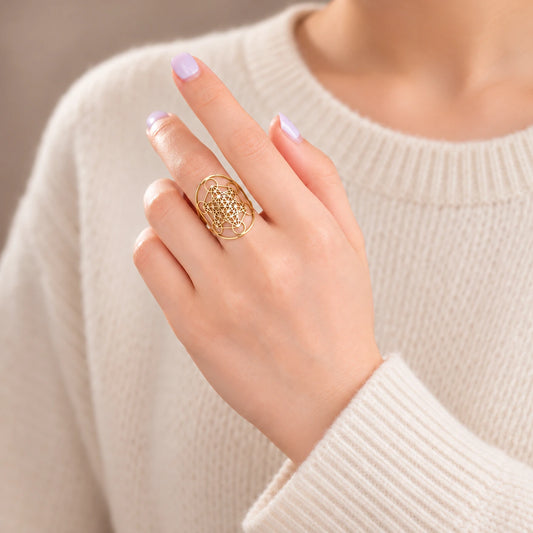
The sacred geometry in decoration allows you to explore several visual rhythms. A star highlights the points, diagonals, and intersections. A drawing based on circles gives more room to curves and rounded spaces.
To choose, look at the room where you want to install the object. A wall already full of motifs can accommodate a simple and well-spaced shape. In a sober space, a more detailed drawing can become the central point of the decoration.
Also ask yourself what you like to observe: a path to follow with your eye, a repetition of curves, or a clear silhouette. Your visual preference constitutes a good starting point for choosing a symbolic object that you will appreciate for a long time.
The Plenitude Flower of Life: another geometric composition
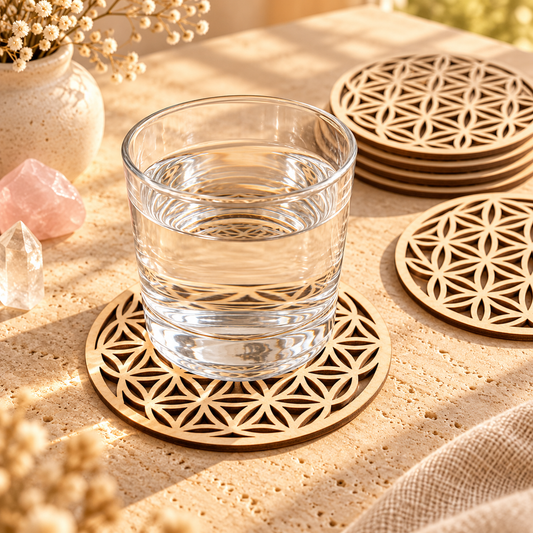
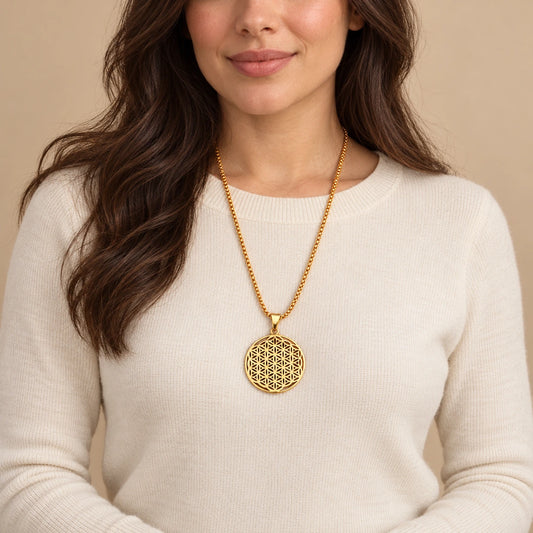
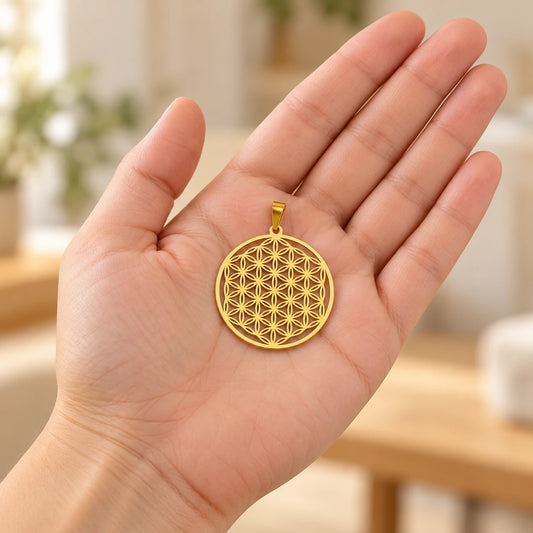
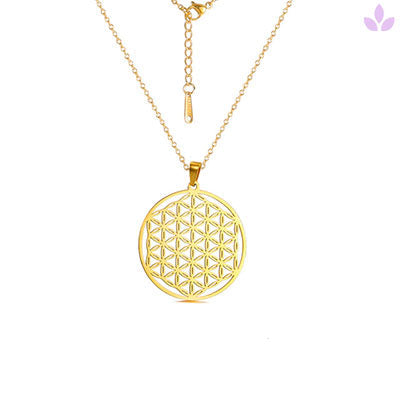
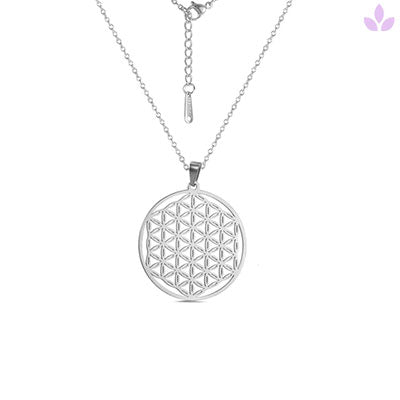
If you prefer curved lines for your interior, the 14 cm Plenitude wooden wall Flower of Life offers an openwork composition based on circular arcs. It is another motif, distinct from the eight-pointed star.

Its circular outline gathers a regular repetition of rounded shapes. The small hole located at the top allows you to identify its hanging point. Look at the size and the cut on the photographs to choose the location that will suit it.
The model also exists in 30.5 cm. You can compare the dimensions and the drawings in our collection of Wooden Flowers of Life. Choose a size adapted to the available space and a contrast that leaves the motif clearly visible.
FAQ – Frequently Asked Questions about the Octagram
What is an octagram?
In geometry, it is the regular star polygon {8/3}, formed of eight points and a path that connects every third vertex.
Do two squares form the same drawing?
Two squares with the same center, offset by 45 degrees, also give eight outer points. Their construction, however, includes two distinct outlines.
Can you draw the octagram in a single stroke?
Yes. The {8/3} path passes through the eight vertices and returns to the starting point without lifting the pencil.
What is its spiritual meaning?
Its symmetry can inspire a reading of order, coherence, or balance. The precise interpretation depends on the context and the intention associated with the drawing.
Is the Flower of Life an octagram?
No. The Flower of Life is a composition of circles and arcs, while the octagram is a star figure formed of segments.
Observe the shape before giving it a meaning
The octagram offers a clear path to explore geometric motifs: count the points, follow the segments, then discover the use of the figure. This attention allows you to appreciate both the drawing and the symbolic reading you wish to give it.