Dodecahedron: meaning, twelve faces and place among the Platonic solids
The dodecahedron is a twelve-sided polyhedron. Its regular convex form, one of the five Platonic solids, consists of twelve identical pentagons. It has thirty edges and twenty vertices. In sacred geometry readings, this organization often evokes wholeness, harmony, and the cosmos.
Its meaning becomes more concrete when you know how to look at the volume. How can you recognize the pentagons? Why do three faces meet at each vertex? What is its relationship with the golden ratio and with the universe in Plato? This guide brings together symbolic interpretation, geometric landmarks, and exercises to explore the form in space.
What is a dodecahedron?
The name indicates the number of faces. A polyhedron with twelve faces can be called a dodecahedron. To specify which shape we are talking about, you must then look at the nature of the faces, their dimensions, and the way they meet. The best-known model in sacred geometry is the regular convex dodecahedron.
In this model, all the faces are regular pentagons. Each pentagon has five equal sides and five equal angles. The edges of the solid therefore have the same length. At each vertex, three pentagons meet in the same organization. This regularity is found everywhere on the volume, regardless of the face chosen as a starting point.
To begin an observation, place the model on a face and look at the one in front of you. Follow its five sides. Then slowly turn the object to find a neighboring face. You will see the same construction appear in another orientation. Repetition allows you to recognize the family of the solid before counting all its parts.

Faces, edges, and vertices: three things to distinguish
A face is a flat surface. An edge is the segment where two faces meet. A vertex is the point where several edges meet. These three words describe different elements, and distinguishing them helps avoid counting errors. In a perspective drawing, an edge may appear short because it recedes from view, while its actual length remains identical to that of the others.
| Element | Number | How to identify it |
|---|---|---|
| Face | 12 | Pentagonal surface |
| Edge | 30 | Segment shared by two faces |
| Vertex | 20 | Point where three edges meet |
All twelve faces are never visible from the same exterior viewpoint on an opaque model. A photograph can therefore show only part of the structure. To check the total number, you must handle the solid, consult a pattern, or follow a counting logic.
The word "side" also requires attention. A pentagon has five sides. The solid, on the other hand, has twelve faces. In everyday conversation, "twelve sides" can be understood as twelve faces, but precise terms are useful as soon as you want to draw, build, or compare objects.
Why does the dodecahedron have thirty edges?
The twelve pentagons each have five sides. If you count the sides face after face, you get twelve times five, which is sixty. But each edge belongs to two neighboring faces. It has been counted twice. You must therefore divide sixty by two, which gives thirty edges.
This reasoning is easy to verify with two adjacent faces. Choose the edge that separates them and first follow the contour of one. You count the segment a first time. Then follow the contour of the other. You encounter exactly the same segment. The general calculation applies this observation to the twelve faces.
If you are preparing an openwork structure with rods of the same length, this result helps you predict the number of elements. The thirty rods correspond to the thirty edges. The junctions then require a three-branched organization. The choice of material and the way to assemble the pieces remain specific to the model you are making.
How to find the twenty vertices?
Once the thirty edges are identified, count their ends. Each has two ends, which gives sixty ends. At the same vertex, three edges meet. These ends are therefore grouped in threes. Sixty divided by three gives twenty vertices.
You can also reason from the faces. The twelve pentagons provide sixty corners if you count them separately. Since three corners of faces meet at each vertex of the solid, you find twenty distinct positions. The two calculation paths lead to the same number.
For visual counting, use a pattern or a model that you can temporarily mark. A small removable sticker on each already counted vertex allows you to keep track. Avoid simply counting the visible points of a photograph. Perspective hides certain junctions and can overlap others.
Euler's check, a verification of the whole
Euler's formula for a convex polyhedron links the three numbers. The number of vertices, minus the number of edges, plus the number of faces, gives two. For the regular dodecahedron, the calculation is twenty minus thirty plus twelve, which is two.
This Euler relationship serves as a global check. If you count twelve faces, thirty edges, and nineteen vertices, the result is one. You must then go back to counting. The relationship does not indicate on its own where the error is, but it signals that the three numbers do not correctly describe the observed convex model.
The check is particularly useful with a pattern. The corners of the flat drawing do not all correspond to different vertices once the volume is closed. Several of them meet when folded. Looking at the groupings of corners helps you understand how a cut surface becomes a three-dimensional object.
What does the dodecahedron represent in Plato?
In the Timaeus, Plato relates the regular forms to a description of the world. After the constructions associated with the four elements, he evokes a fifth form used for the arrangement of the universe. This passage, at 55c, is at the origin of the association of the dodecahedron with the cosmos in readings of his thought.
This particular place explains the power of the symbol. The dodecahedron can evoke a whole that brings together the parts within an order. The identical pentagons give an image of coherence. The closed volume gives an image of wholeness. The meaning arises from the meeting between the cosmological text and the form.
To read a contemporary object presented as a Platonic solid, look at what interpretation accompanies it. Some models emphasize geometry, others meditation or decoration. The vocabulary of the cosmos allows you to understand a tradition of reading, while the twelve pentagons allow you to identify the object.
Why is it sometimes associated with ether?
In several directories of sacred geometry, the dodecahedron is presented with ether or an idea of a fifth principle. This reading insists on what envelops, connects, or completes the elements. It extends the special place given to the fifth form in the symbolism of the solids.
When you compare two presentations, observe their words. "Cosmos," "wholeness," and "ether" can be found around the same object while emphasizing different aspects. The first refers to an organized universe, the second to the whole of the parts, the third to a vocabulary of elements and their articulation.
To choose a personal reading, you can start with what the form allows you to observe. The presence of opposite faces can evoke balance. The repetition of a pentagon can evoke a unity that is found everywhere. The center of the volume can offer a landmark to think about the relationship between inside and outside.
The pentagon, the shape present on each face
A regular pentagon has five interior angles of 108 degrees. This value helps you understand how the faces fit together. At the vertex of the dodecahedron, three of these angles meet. Their sum is 324 degrees. It remains less than a full turn of 360 degrees, which allows the volume to stand up instead of remaining flat.
To see it, cut out three regular pentagons from paper and bring one vertex of each together. Keeping the neighboring sides in contact, you will notice that there is still an opening. Folding allows you to locally close this opening by creating a three-dimensional corner. This small assembly gives a first intuition of the structure of the solid.
The difference of 36 degrees between 324 and 360 is an angular defect at the vertex. It is a geometric way of measuring how the surface leaves the plane at that point. It does not correspond to the angle between the two neighboring faces, which is another measure. Distinguishing these angles allows you to more precisely follow the technical descriptions of a model.
What link exists with the golden ratio?
The golden ratio appears in the geometry of the regular pentagon. If you connect two non-neighboring vertices of a face, you draw a diagonal. The ratio between its length and that of a side is the golden ratio, generally denoted by φ and close to 1.618.
A side of 2 cm therefore corresponds to a diagonal of approximately 3.24 cm. A side of 4 cm gives a diagonal close to 6.47 cm. The ratio remains the same when you enlarge the figure, because all lengths are multiplied in the same proportion.
To observe this link on a model, choose a clearly visible face and look at the segments that could be drawn between its vertices. The edges of the solid follow the sides of the pentagon. The diagonals would cross the face. On a solid object, they can be imagined or drawn on a copy of the drawing, without marking the model itself.
This relationship explains part of the interest shown in the dodecahedron in readings of sacred geometry. The golden ratio is present in each of its twelve faces. A local proportion repeats itself in the entire volume. The form thus invites you to look at how the same rule is found at several scales.
What is the difference between a dodecahedron and an icosahedron?
The regular dodecahedron is recognized by its pentagons. The regular icosahedron has twenty triangular faces. If you have a die or a decorative object in front of you, the first step is therefore to look at the shape of a face, rather than to count the visible points in the silhouette.
The numbers of faces and vertices correspond to each other. The dodecahedron has twelve faces and twenty vertices. The icosahedron has twenty faces and twelve vertices. Both have thirty edges. This correspondence leads to the notion of dual solids.

The two volumes can appear close from afar because they distribute many small faces around a center. A grazing light helps to distinguish them. It makes the edges of each face and the number of segments that compose its contour appear.
What does it mean to say that two solids are dual?
To imagine duality, place a point at the center of each face of the dodecahedron. Connect the points of the faces that share an edge. The new segments build another volume inside the first. With an appropriate scale, its shape is that of a regular icosahedron.
Each face of the starting solid becomes a vertex of the new one. Each vertex of the first corresponds to a face of the second. The numbers therefore naturally exchange. The thirty edges maintain a correspondence between the two constructions.
This geometric duality also offers a beautiful way to think about viewpoints. The same whole can be organized by emphasizing its surfaces or its junctions. In a symbolic reading, one can see a relationship between what welcomes and what connects. Personal meaning then starts from a transformation that can actually be represented.
To avoid losing track in a drawing, choose only three neighboring faces and mark their centers. The three points draw a triangle around a vertex of the dodecahedron. This small triangle gives a first image of a face of the dual solid, even before representing the entire construction.
How does the dodecahedron approach a sphere?
The twenty vertices of the regular dodecahedron are at the same distance from its center. You can therefore imagine a sphere that passes through all these vertices. The twelve faces also touch another sphere, smaller, by their centers. These two envelopes help to understand the regular distribution of the volume.
In an opaque object, this relationship becomes perceptible when you turn the model. A face comes to the foreground, then gives way to another. The contour changes, but the center seems to remain stable. The succession of facets gives an impression of roundness while keeping flat surfaces.
This visual property can contribute to the cosmological reading of the form. A closed volume organized around a center lends itself to the image of wholeness. Geometric observation and symbolic reading meet here, without asking the eye to know all the formulas of the solid.
What is the actual size for a dodecahedron model?
The length of an edge does not directly give the total bulk. For a regular dodecahedron, the radius of the sphere that passes through the vertices is approximately 1.401 times the edge. An edge of 2 cm therefore gives a radius close to 2.80 cm and a distance of approximately 5.61 cm between two opposite vertices.
These measurements are useful for choosing a decorative object. A model announced with an edge of 4 cm can occupy a space much greater than 4 cm. Look if the sheet specifies a height, a maximum diameter, or an edge length. The word used changes the way of understanding the dimension.
To predict the space on a shelf, also measure the eventual support. A base or a pedestal adds height. If you are making a paper model, a first small-format trial allows you to check the final volume before choosing a thicker material.
How do the symmetries become visible?
A regular solid can be turned in certain directions and regain an equivalent appearance. On the dodecahedron, the axes passing through the centers of opposite faces allow notably rotations related to the five sides of the pentagons.
Place the model on a face and look at it from above. A rotation of one-fifth of a turn makes one position pass to the next around this axis. The contour of the upper pentagon is found in an equivalent orientation. You can continue until returning to the starting position.
Other axes pass through opposite vertices or through the centers of opposite edges. They highlight other repetitions of the structure. It is not necessary to memorize the entire group of symmetries to start. Choosing a single rotation and observing what repeats already allows you to understand the principle.
This observation is easier with a solid-colored model. A different color on each face draws more attention to the identity of the surfaces. A uniform shade emphasizes the repetition of the form. The two approaches can be useful depending on what you want to explore.
How to read a dodecahedron pattern?
A pattern presents the twelve pentagons in a plane. Some edges are kept as fold lines. The others will meet during assembly. Tabs can be added to allow gluing, but they do not become additional faces of the solid.
Before cutting, count the twelve pentagons and check that they are the same size. Then look at the edges to be connected. A good pattern clearly indicates the folds and the gluing areas. If several lines are of the same appearance, mark your landmarks on a copy to avoid cutting a place intended to be folded.
The pattern also shows why the corners of the drawing cannot be counted as distinct vertices. During assembly, three corners belonging to different faces come together. The geometry of the volume appears gradually as these groupings close.
A method for assembling a first paper model
Choose a pattern of twelve pentagons and print it on paper firm enough to keep the folds. Paper that is too thin can deform near the junctions. Very thick cardboard, on the contrary, makes small folds difficult to form. For a first trial, a fairly large format helps to see the connections.
First locate all the folds with a ruler and a light mark adapted to the paper. Then lift the faces without gluing to understand their position. This dry step allows you to see which edges will meet. You can number the connections on the inside, so as to keep the outer faces readable.
Glue gradually, allowing each group of faces time to hold. The final opening should remain wide enough to slide in the last tabs. Rushing the assembly can misalign the faces and make closing difficult, even if the pattern was correct.
When the model is finished, place it on several faces. See if the joints remain neat and if the volume retains its shape. A small misalignment does not change the value of the exercise. It simply indicates where a length, fold, or gluing job deserves to be revisited on a future model.
Why do twelve pentagons allow the volume to close?
The faces come together in an organization that repeats around the twenty vertices. Each pentagon shares its five sides with five neighbors. By continuing the connections, we obtain a closed envelope in which all the faces fulfill the same role.
It is useful to follow this idea on the finished model. Choose one face as a starting point and identify the five faces surrounding it. Then turn the solid over to see the opposite face and its surroundings. The object can thus be approached as two regions that correspond to each other around the same structure.
This way of looking makes it easier to read perspective drawings. When we recognize a central face and its crown of neighbors, we can mentally reconstruct part of what is hidden. The drawing becomes less mysterious because the relationships of the volume are known.
How to draw a dodecahedron without losing its structure?
Perspective drawing presents a particular difficulty: the regular pentagons of the solid do not all retain the same appearance on the page. A tilted face appears narrower, while a face almost turned toward you appears larger. This distortion belongs to the representation of the volume. It does not mean that the model has different faces.
To begin, use a photograph of a simple model, placed on a plain background. First draw the general silhouette, then identify a clearly visible face. Add the neighboring faces one by one, checking their meeting points. Do not try to draw all the hidden edges immediately: they can wait for a second version of the drawing.
Choosing a readable viewpoint
A view directly facing a pentagon clearly shows the organization around this face. A view directed toward a vertex highlights the three faces that meet there. These two orientations tell the same object, but they do not emphasize the same aspect. The first highlights the five-sided structure; the second helps to understand the relief.
For a geometry notebook, make both drawings side by side. Add a short caption under each and indicate what is in the foreground. You get a concrete observation exercise: a small rotation is enough to transform the silhouette without changing the properties of the solid. This experience makes the notion of perspective much more accessible.
Representing the hidden parts
In a technical drawing, invisible edges can be drawn with dashed lines. They complete the structure, but quickly become difficult to read if they have the same intensity as the visible lines. Therefore, keep a lighter line for the back. A simple outline drawing may remain preferable in a decorative illustration.
If a representation seems strange to you, examine the vertices before the shadows. On a regular dodecahedron, three faces meet at each vertex and each face has five sides. An image that multiplies triangles or shows four faces around the same vertex represents another construction, or contains a drawing error. These two criteria constitute a quick check.
Why does this shape evoke totality and harmony?
The symbolism of the dodecahedron is based first on an impression of unity. No face stands out by its shape or size. By turning the solid, the gaze finds the same relationships, organized around a center that the surface does not directly show. This continuity explains its appeal in contemporary sacred geometry.
Its twelve faces offer several viewpoints on the same whole. One can read in it an invitation to connect the aspects of a situation, to consider what is visible and what remains hidden, or to seek coherence between different experiences. This reading lends itself particularly well to the contemplation of an object that can be turned in one's hands.
The number twelve and the idea of a cycle
The number twelve appears in many referencing systems: the months of the year or the hours marked on a dial are familiar examples. It allows one to share a whole into several groups, since it is notably divisible by two, three, four, and six. This flexibility contributes to its presence in representations of order and time.
The twelve faces can thus serve as a personal support for reflection on cycles. One can assign a month to each face of a paper model and write down a memory, an intention, or a step. The solid then becomes a symbolic calendar. This use is a practical creation, without assuming that geometry was originally designed to represent our calendar.
The same distinction is useful with the twelve signs of the zodiac. Their number allows a visual connection, but it is not enough to establish a precise ancient correspondence between each sign and each face. If you wish to create an astrological object, simply indicate the chosen system. You thus give a clear meaning to your creation.
A unique center and several orientations
The center of the solid remains the same when the object turns. This property offers a telling image of recentering: perspectives change, while a point of reference remains. In a contemplative practice, one can start from a face, follow an edge, then imagine the center of the volume. Attention gradually passes from the detail to the whole.
The interest of the symbol comes here from its visible organization. A model placed at eye level allows one to distinguish lit areas, areas of shadow, and hidden parts. One can associate these differences with the multiple aspects of an experience, then return to the unity of the form. The reflection remains linked to what we actually observe.
Regular, stellated, or Roman dodecahedron: three expressions to distinguish
The word dodecahedron can refer to very different objects as soon as a qualifier is added. To understand an illustration, a book, or a museum card, therefore start by reading the full name. The number of faces does not alone inform about their shape, their equality, or the way they come together.
The convex solid with pentagonal faces
The model studied in this article is the convex regular dodecahedron. It presents neither hollows nor inward points. Its twelve pentagons are identical, and each edge connects two neighboring vertices. It is this shape that is classified among the Platonic solids and that is generally used for the first paper constructions.
The term convex has a concrete meaning: if we connect two arbitrary points of the solid with a segment, this segment remains in the solid. A rounded faceted silhouette can help to perceive it, but the definition depends on the complete structure. It depends neither on the material used nor on the color of the object.
The stellated versions
Stellated shapes extend the work on planes and intersections. Some present spectacular points that can recall a three-dimensional star. They belong to a more advanced study of polyhedra. Their appearance should not lead to automatically reusing the assembly rules of a convex model with twelve simple pentagons.
For a first purchase or a first search, therefore check the title and the photograph. An object bristling with points will not give the same visual experience as a convex dodecahedron. In a meditation space, the choice can follow your aesthetic sensitivity; in a pedagogical activity, it is better to start with a shape whose faces remain easy to count.
Gallo-Roman archaeological objects

Museums also preserve metal objects called Gallo-Roman dodecahedrons. Their faces are pierced and their vertices bear small buttons. The National Museum of Archaeology presents one of these objects and recalls the uncertainty surrounding their function. They open another subject: that of material uses and archaeological enigmas.
The hypotheses proposed about them do not constitute a general explanation of the Platonic solid. A possible tool, a prestige object, and a cosmological figure belong to different contexts. Before adopting an interpretation, look at the provenance, the period, and the characteristics of the specimen concerned. The common shape invites comparison; the details allow one to distinguish.
This comparison is particularly interesting during a museum visit. A paper model emphasizes the equality of the faces. An ancient object draws attention to its openings, its traces of manufacture, and its material. We thus move from an abstract definition to a historical question, without confusing the evidence necessary for each.
Three exercises to explore the shape yourself
A small model is enough to put into practice the properties covered in this guide. Choose an object large enough to follow the edges with your eyes, or make a version in thick paper. Work on a clear table and keep a pencil at hand. The goal is to make the relationships visible rather than to memorize a list of numbers.
Find the six pairs of opposite faces
Place a small removable marker on one face and look for the one that faces it on the other side of the center. Start again with another color. The twelve faces are divided into six opposite pairs. On a regular model, the planes of two opposite faces are parallel, which helps to understand their relationship when the object is turned.
Once the pairs are identified, draw six colored lines on a sheet and give each pair a complementary intention: learning and transmitting, starting and finishing, acting and resting. It is a creative proposal that you can adapt. Geometry provides the support; the words come from your own reflection.
Follow a face-to-face path
Number the faces on a paper model. Choose a starting face and cross an edge to reach a neighbor. Note your path, then look for a different path to the same destination. You will discover that a closed surface offers several possible paths. The result depends on the neighborhoods between the faces, without the need to cross the volume.
To extend the exercise, try to visit several faces without immediately retracing your steps. Then compare two written paths. This activity develops spatial reading and gives concrete content to the idea of a journey: we move forward thanks to points of passage, and a destination can be approached from several directions.
Observe the light on the pentagons
Place the model near a window, away from direct sunlight if its material is sensitive. Look at the brightest face, then at the one that appears darkest. Turn the object gently. A face retains its shape while changing appearance according to its orientation. This observation allows to separate the geometric property from the effect produced by the lighting.
You can finish with a quick sketch of three neighboring faces, with three values of gray. This exercise gives relief to the drawing and slows down the gaze. It is also suitable for a moment of calm in a personal space: a few minutes are enough to observe a structure with attention, without seeking to obtain a particular experience.
What place to give the dodecahedron in a symbolic decoration?
A geometric shape easily finds its place in an interior when it has a little space around it. A clear shelf, a small table, or a reading corner allow one to observe its facets without multiplying objects. Before choosing its location, look at the available light and the distance from which you will see it most often.
A wooden model brings a warm presence; a paper version highlights the folding and the construction; a metal object emphasizes the edges and the reflections. These materials change the atmosphere and the touch, while the geometry of the dodecahedron remains the same. The choice therefore depends as much on your use as on your taste.
Create a small coherent set
For a space dedicated to contemplation, associate the volume with a notebook and a clear surface. You can write down an idea, draw a face, or revisit an observation exercise. A single well-chosen shape can become a daily landmark, especially if its location allows you to look at it without moving several objects.
If you also like flat representations, an image of sacred geometry creates an interesting dialogue with the solid. The drawing immediately shows its lines; the volume requires turning around it. This difference enriches the whole. However, keep a simple visual hierarchy, with a main object and a discreet accompaniment.
Extend this interest with a sacred geometry jewelry
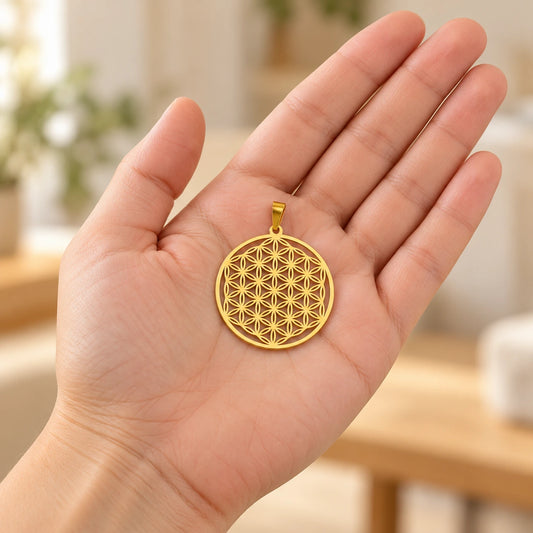
The Metatron's Cube is part of the motifs appreciated for their circles and their intersecting lines. It offers another way to carry an interest in sacred geometry: an openwork design is discovered as the gaze follows, while a polyhedron is discovered by its faces and its volume. These two approaches can accompany the same sensitivity to shapes.
The Blooming Metatron pendant with silver finish takes this motif in a circular medallion. Its design constitutes a relevant choice if you are looking for a symbolic jewelry linked to geometric networks. To explore other motifs, also discover our collection of sacred jewelry and protection symbols.

The frequent errors when seeking the meaning of the dodecahedron
The first confusion consists in counting the visible parts of a photograph as if they represented the whole solid. Several faces remain hidden behind the object. To check the total number, use a model that you can turn, a complete pattern, or a precise geometric description. An image alone gives a viewpoint, not an exhaustive inventory.
A second error consists in considering any twelve-faced shape as regular. The number twelve does not guarantee the equality of the faces or the edges. A deformed model can retain twelve faces while losing the desired regularity. When proportions matter for your activity, therefore look at the construction and the announced measurements.
Finally, separate the symbolic correspondences from the calculable properties. The number of edges is deduced from the number of sides of the faces. A personal intention, however, is chosen according to the meaning you give to the object. This distinction makes both approaches richer: the structure becomes understandable and the symbolism keeps a living place.
FAQ – Frequently Asked Questions about the Dodecahedron
What is the spiritual meaning of the dodecahedron?
It mainly evokes unity, the order of the cosmos, and the harmony of a whole composed of several parts. This reading finds a point of support in the particular place of the fifth construction in Plato. In contemporary uses, its facets and its center can also accompany a reflection on cycles, viewpoints, and recentering.
How many faces does a regular dodecahedron have?
It has twelve faces, all made of identical regular pentagons. Each face therefore has five equal sides and five equal angles. The faces come together with three pentagons around each vertex. It is the association of these properties that defines the convex regular model, beyond the only number of faces indicated by its name.
Why does it have thirty edges and twenty vertices?
The twelve pentagons give sixty sides counted separately. Each edge being shared by two faces, we obtain thirty edges. The same faces give sixty corners; three faces meeting at each vertex, we obtain twenty vertices. These results are verified with Euler's relation: twenty minus thirty plus twelve equals two.
What is the link between the dodecahedron and the golden ratio?
The link is found notably in the regular pentagon. The ratio between the length of a diagonal and that of a side is equal to the golden ratio, which is approximately 1.618. Since the regular dodecahedron is composed of regular pentagons, this proportion belongs to the geometry of each of its faces. It is also found in the calculations of the solid's dimensions.
What difference with the icosahedron?
The regular dodecahedron has twelve pentagonal faces and twenty vertices. The regular icosahedron has twenty triangular faces and twelve vertices. Both have thirty edges. They are duals: by correctly connecting the centers of the faces of one, you construct a model of the other. This relationship exchanges the roles of the faces and the vertices.
Does the dodecahedron represent the ether for Plato?
The Timaeus associates the fifth construction with the universe. The association of the dodecahedron with the ether is common in later and contemporary symbolic presentations of the five solids. To read the text accurately, it is better to retain its cosmological formulation and distinguish this particular place from more recent correspondences between forms and elements.
Can you make a dodecahedron out of paper?
Yes, with a suitable template featuring twelve regular pentagons and glue tabs. Fairly thick paper makes the model easier to hold. Score the folds before assembly, check the direction of the tabs, and gradually close the volume. The tabs are used to fix the faces; they should not be added to the count of the pentagons.
Why do the faces look different in a photo?
Perspective visually shortens the inclined faces. The lighting also changes their contrasts, which can reinforce this impression. On a regular model, however, the pentagons remain identical. To see this for yourself, turn the object until you successively present several faces in a comparable orientation, or examine the pieces of the template before assembling them.
What were Gallo-Roman dodecahedrons used for?
Their function remains debated. These metallic archaeological objects, pierced and equipped with small buttons, must be studied according to their context of discovery and their characteristics. They do not constitute automatic proof of a spiritual use of Plato's solid. A museum label is a good starting point to discover a specific example.
How to use this shape in a moment of meditation?
Place a model in front of you and observe one face, its five sides, then its neighbors. Then let your gaze consider the whole and imagine its center. You can associate this transition from detail to volume with a personal intention of coherence or openness. A short and simple session is enough to make the shape a support for attention.
A shape to understand, build, and contemplate
The dodecahedron combines a precise structure and great visual richness: twelve pentagons, thirty edges, twenty vertices, and multiple orientations around the same center. Its place in Plato's thought explains part of its symbolic appeal, while its construction allows you to concretely discover the relationships between the plane and the volume.
Start with what attracts you most: counting the faces, making a template, drawing a perspective, or placing a model in a quiet space. By returning to the shape itself, you will be able to build a personal understanding of its symbolism, nourished by observation and by the pleasure of discovering geometry.