Prayer wheel: meaning, mantra and significance of movement in Buddhism
The prayer wheel is a ritual object in Tibetan Buddhism: a cylinder rotates around an axis and contains mantras inscribed on a rolled support. The best known is Om mani padme hum, associated with compassion. Turning the wheel extends the recitation of the mantra into a gesture.
Small portable models and large cylinders arranged near places of practice can be found. To understand their meaning, let's look at what they contain, the direction of rotation, and how the movement is incorporated into spiritual life.
What is a Tibetan prayer wheel used for?
In the tradition, the Tibetan prayer wheel is used to set the mantras in motion and to accompany an intention of compassion towards beings. The rotation is part of a practice that brings together body, speech, and mind. The visible gesture takes on its meaning in this inner orientation.
The object is therefore not reduced to its mechanism. A cylinder can easily turn, but the practice gives it a direction: remembering the mantra, cultivating an intention, and participating in a transmitted tradition. The wheel constitutes both a material support and a spiritual guide.
The Musée des Confluences presents prayer wheels as emblematic objects of Tibetan Buddhism, used by both monastics and laypeople. This presence in daily life explains why they are seen both in the hands of practitioners and in sets installed near monasteries.

How does this object work?
The portable model includes a cylindrical drum mounted on an axis and a handle allowing it to be held. A small chain and a weight can help maintain the rotation. The cylinder turns while the hand holds the support.
Inside is a support bearing mantras, generally rolled around the axis. Inscriptions may also appear on the outside. The mantra roll belongs to the heart of the object: the practice concerns the sacred words it contains, and not just the visible patterns on the metal.
The large wheels follow the same general principle, with a different scale and a different mode of propulsion. Some are operated by hand as you pass by. Other devices use natural force or a mechanism. The cylindrical shape makes continuous movement particularly visible.
What mantra is in the wheel?
Om mani padme hum is the mantra most frequently associated with prayer wheels. It is linked to Avalokiteshvara, called Chenrezig in Tibetan, the figure of compassion. Its six syllables hold an important place in Tibetan devotional practices.
The formula is often associated with the jewel and the lotus. However, the teachings give it a richer scope than a simple word-for-word translation: its syllables are explained in a path of transformation and compassion. To understand a specific practice, the teaching that accompanies it constitutes the best guide.
The mantra can be recited aloud or inwardly during the rotation. The gesture and the word then follow the same intention. This association gives another way of understanding the movement: each turn is part of a continuity of attention.
In which direction should it be turned?
In usual Tibetan Buddhist practice, the wheel turns clockwise. This direction is also associated with the circulation around many sacred objects and places. It places the action in a shared ritual orientation.
For a small model, the movement of the wrist maintains a regular rotation of the drum. It is not necessary to seek great speed. The clarity of the gesture, the comfort of the hand, and the attention paid to the practice matter more than mechanical performance.
During a visit, follow the customs and indications of the place. A row of wheels is discovered by leaving space for other people and respecting the direction of the path. Some objects displayed in museums are viewed without being handled.
Why is compassion at the center of its meaning?
The link with Chenrezig gives the wheel a particular orientation: the wish for the well-being of beings. The practice of Buddhist compassion invites to broaden attention beyond immediate concerns. The mantra and the movement serve as reminders of this intention.
In traditional presentations, we also speak of the accumulation of merit and purification. These terms belong to the spiritual framework of the practice. They express a way of understanding the effects of an act oriented towards awakening and the well-being of others.
For a first reading, remember the link between three elements: a mantra associated with compassion, a movement that extends it, and an intention that gives it its meaning. This relationship explains the object better than the mere fact of counting its turns.
Small portable wheel and large monastery wheels
The portable prayer wheel accompanies a journey or a moment of personal practice. Its size allows it to be held in the hand. The metal, the handle, and the counterweight form a set adapted to this repeated movement.
The large cylinders installed in a place of practice are more part of a collective path. The visitor moves from one wheel to another. The object becomes part of the architecture and the journey, just like the passages and the spaces of contemplation.
The differences in size do not change the central idea: the mantras contained are set in motion. To observe a photograph, look at the axis, the way the cylinder is operated, and the environment. These details allow you to understand how the model is used.
What difference with a mala?
The mala is a rosary that allows, among other things, to follow the recitations with the help of its beads. The practitioner moves from one bead to the next. With a wheel, it is the cylinder containing the mantras that turns around its axis.
| Support | Characteristic gesture | Main guide |
|---|---|---|
| Prayer wheel | Turning a cylinder | Mantras contained in the drum |
| Mala | Sliding the beads | Following the recitations |
| Dharma Wheel | Observing an emblem | Representation of the teaching |
The comparison shows that objects linked to the same spiritual universe can fulfill distinct functions. To deepen the study of the rosary, our article on the Tibetan mala and its 108 beads presents its main guides.
Is the Dharma Wheel a prayer wheel?
The Dharma Wheel is a symbol of Buddhist teaching. In its eight-spoked representation, it refers notably to the noble eightfold path. It can be drawn, sculpted, or worn as an emblem.
The wheel is an object that is turned, with a ritual content and use. The two images share the theme of movement, but their functions are distinct. This difference helps to read museum legends and object descriptions.
Our guide on the meaning of the eight spokes of the Dharma allows you to explore this emblem. The word wheel is not enough to give the same meaning to all circular forms in Buddhism.
Observing a prayer wheel with three simple questions
Start with the construction: how is the cylinder held and propelled? This question helps you identify the functional parts. You will more easily distinguish the handle, the drum, and the elements that maintain the rotation.
Then look at the inscriptions and the decoration. A collection card can specify the materials, the origin, and the text represented. If you cannot read the script, keep this question open and look for a reliable transcription rather than deducing the mantra from the sole aspect of the object.
Finally, consider the environment: is it a personal object, an installation used in a sanctuary, or a museum piece? The context explains what you can observe and the place of the object in a path of practice or discovery.
Another support to accompany a time of meditation
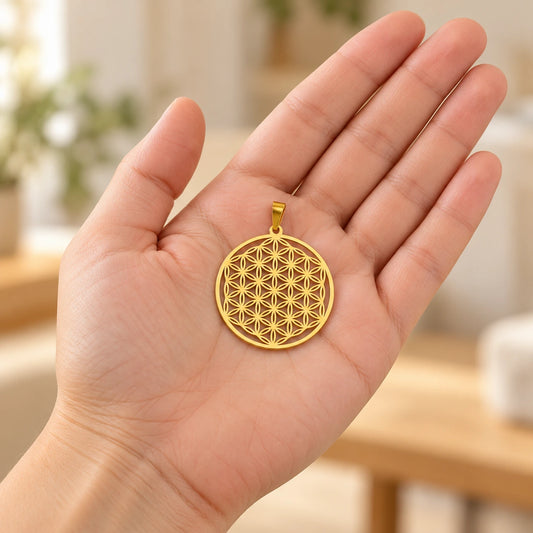
If you wish to explore the gesture of the beads, the Flower of Life Tibetan Mala Bracelet combines 108 wooden beads with a Flower of Life medallion. It offers another symbolic support, which can be worn or accompany a time dedicated to attention.
To compare different motifs, discover our collection of jewelry and sacred symbols. First choose the meaning and the gesture that interest you: a motif to contemplate, beads to slide, or an object belonging to a specific practice.

Reserve for your time of practice a simple setting, with a comfortable seat and a little calm. Regularity is built more easily around a gesture that is understood and a realistic time in your day.
FAQ – Frequently Asked Questions about the Prayer Wheel
What is a prayer wheel used for?
In Tibetan Buddhism, it sets the mantras it contains in motion. The gesture accompanies an intention of compassion and is part of a transmitted spiritual practice.
What mantra does it most often contain?
Om mani padme hum is the best known mantra in this context. It is associated with Chenrezig, the figure of compassion in the Tibetan tradition.
Why do we turn clockwise?
This direction belongs to the usual Tibetan Buddhist ritual use. It links the rotation of the wheel to the orientation of many paths around sacred objects and places.
Should the mantra be recited while turning it?
The recitation can accompany the rotation, aloud or inwardly. For a formal practice, follow the explanations of the tradition or the center that welcomes you.
Do a wheel and a mala serve the same way?
The wheel turns a cylinder containing the mantras. The mala allows you to follow the recitations by moving from one bead to another. Their gestures are different.
A movement linked to an intention
The meaning of the prayer wheel is understood in the relationship between its content, its rotation, and compassion. The cylinder makes the movement visible; the mantra and the practice give it its spiritual scope.
By observing the mechanism, the text, and the context, you will be able to recognize this object and better understand the place it occupies in Tibetan Buddhist life.