Shou Symbol: Meaning of the Chinese Character for Longevity
The Shou symbol represents longevity in Chinese culture. It comes from the character shòu, written 壽 in its traditional form and 寿 in its simplified form. On calligraphy, textiles, or decorative objects, it expresses a wish for a long life and thoughtfulness toward the person who receives it.
Why do we find round, elongated, or highly stylized versions of this character? And how can we understand its message in a gift? Here are the key features to help you recognize Shou, distinguish its different forms, and understand its main decorative styles.
What does Shou mean in Chinese?
Shou, transcribed as shòu in pinyin, refers to longevity and a long life. In the context of well-wishes, it takes on the value of a benevolent wish. The character gives visible form to an intention directed toward a person, particularly on the occasion of a birthday.
This idea has a relational dimension. Giving an object bearing the Shou is a way of recognizing the value of a life and wishing that it may continue. The message can be accompanied by respect, affection, and gratitude toward previous generations.
The meaning does not depend solely on the appearance of the sign. The person who gives it, the occasion, and the other elements of the object also contribute to the message. Calligraphy kept within a family has a different history from a repeating pattern on a textile, even though the character may be recognizable in both cases.
Why are there two forms, 壽 and 寿?
The traditional character 壽 has a more elaborate structure. The simplified form 寿 uses fewer strokes. In this context, both forms refer to the same word; their visual difference does not change the wish for longevity into a different message.

To recognize an inscription, start by identifying its writing system and style. A printed form makes the strokes easier to read; calligraphy may connect or emphasize them. Decorative versions add even more transformations, especially when the design is adapted to a circle.
If you are preparing a card or engraving, choose a version whose meaning you know. Keep a reliable model next to your creation. This practical precaution helps prevent missing strokes and allows you to provide a simple explanation to the recipient.
The Round Shou and Decorative Forms
The Shou of longevity appears in many graphic variations. Some are elongated, while others are set within a circular form. The Getty Research Institute describes these patterns, in particular, as elements that can form a central medallion or a repeating border in Chinese rugs.
The transition from a character to a pattern changes the way we look at it. In everyday writing, the eye first seeks to read. In a stylized medallion, it also notices the symmetries, negative spaces, and the rhythm of the lines. The character becomes part of the decorative composition.
To identify a highly transformed version, compare it with several documented examples. A geometric circle is not enough to identify a Shou. The details of the strokes and the context of the object help reveal its connection to the character.
Where Can This Chinese Symbol Be Found?
Shou patterns appear on a variety of media: calligraphy, textiles, ceramics, and decorative elements. The sign may occupy the center of a surface or appear several times within a composition. Its placement influences how the wish is highlighted.
A large central inscription immediately draws attention to the wish. A repeating border integrates it more fully into the decoration. On a small object, stylization makes it possible to maintain a legible silhouette despite the reduced size.
In a museum collection, look at the object's origin and date, then at the pattern's description. This information allows you to observe a specific example. It helps prevent reducing very different media to a single general history of the sign.
What Is Its Connection to Birthdays?
The wish for a long life accompanies birthday celebrations and expressions of respect toward elders. Shou allows this wish to be written concisely. It can be presented on its own or integrated into a more elaborate composition, depending on the object and the occasion.
When choosing a gift, start with your relationship with the recipient. Do you want to express gratitude, celebrate their life's journey, or preserve the memory of a shared moment? The answer helps you choose the medium and the words that will accompany the character.
A personal message adds warmth to the symbol. You can mention a quality you admire or a specific memory. The wish thus becomes a thoughtful gesture directed toward someone, rather than an inscription whose meaning remains unexplained.
Our article on symbolic gifts for a mother or grandmother offers other ways to connect an object to a family story. The best choice also depends on the tastes of the person who will receive it.
Shou, Longevity, and the Memory of Generations
Longevity evokes the time one has lived, but also what is passed down through the years. A given character may recall an important presence in the family, an enduring bond, or gratitude for a person's experience.
This interpretation lends itself well to a composition combining an inscription with a keepsake. A photograph, a date, or a few handwritten words can clarify the intention. The symbol then retains its cultural meaning while taking its place in a particular story.
For a retirement gift, the focus may be on the continuity of a career and the time that lies ahead. Our selection of symbolic retirement gifts explores this other occasion for celebrating a life milestone.
How to Showcase a Shou Calligraphy Piece
Start by leaving enough space around the character. A plain background makes it easier to distinguish the strokes and the spaces between them. Simple framing can highlight the inscription without competing with it. The distance from which the object will be viewed is just as important as its size.
A highly stylized composition sometimes deserves a brief explanation on the back or in the accompanying card. You can state the word Shou and its meaning of longevity. This simple presentation helps the recipient understand the message even if they cannot read Chinese.
For a lasting drawing or engraving, have the chosen character checked before it is made. Legibility is developed from a precise model, especially when the lines have been heavily transformed to fit into a circular form.
Another Symbol to Carry with You Every Day
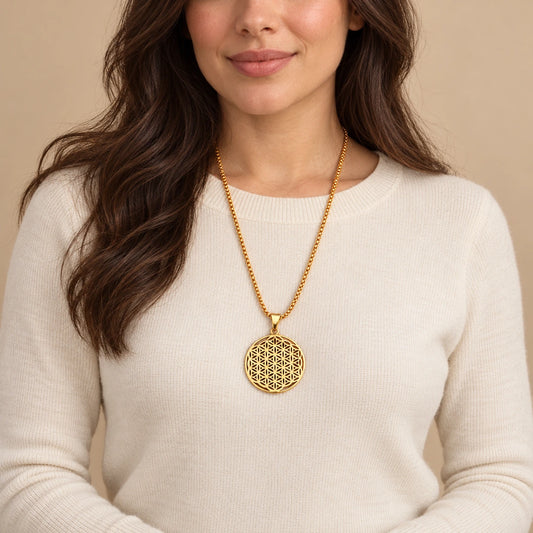
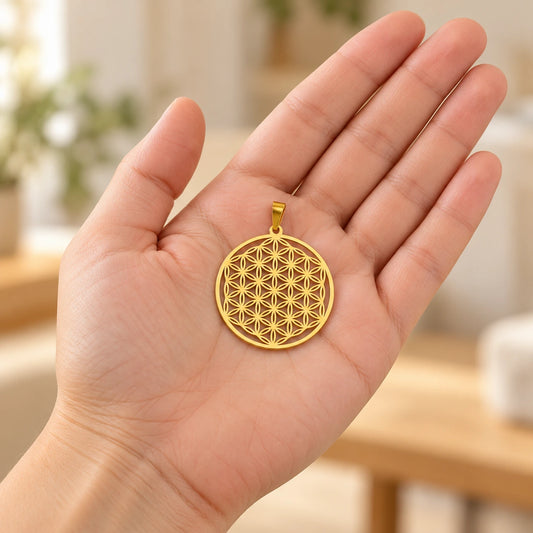
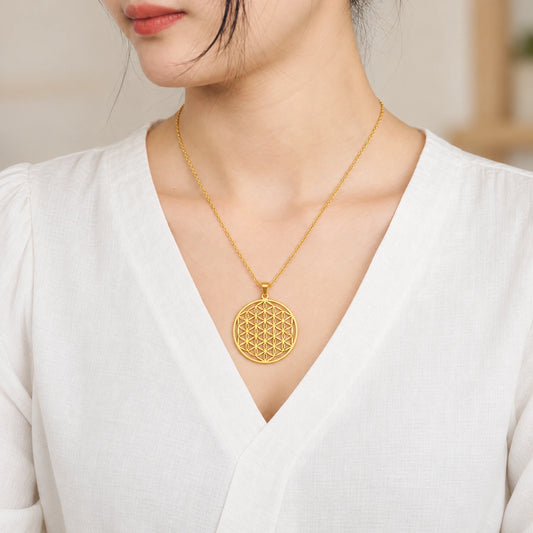
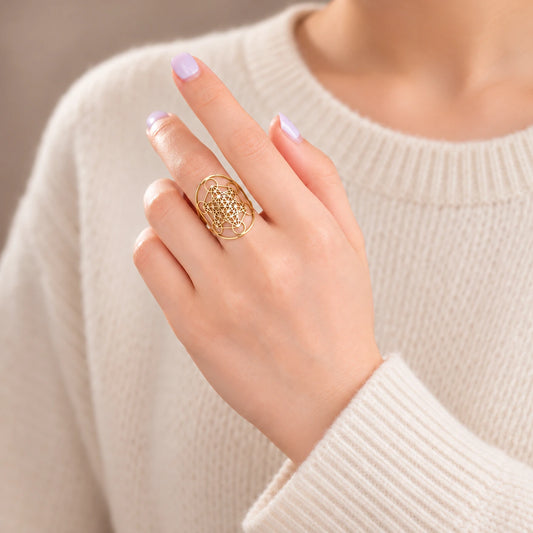
The wish for continuity can also be expressed through a pattern of cycles and connections. The Fleur de Vie offers another visual language, built from overlapping circles. A small object allows you to keep this design close to you and associate it with a personal gesture.
The Fleur de Vie Keychain features a circular medallion connected to its ring by a short chain. It can accompany a set of keys or an everyday gift. Discover our collection of Fleur de Vie accessories to compare sizes.

To explain your choice, start with the design and the intention. A written character directly expresses a word; a geometric pattern invites a different interpretation. In both cases, a few personal words help the recipient understand the meaning of the gift.
FAQ – Frequently Asked Questions About the Shou Symbol
What does the Shou symbol mean?
It represents longevity and can express a wish for a long life. It comes from the Chinese character shòu, used in inscriptions and decorative compositions.
What is the difference between 壽 and 寿?
壽 is the traditional form and 寿 is the simplified form. In the context of this article, both forms refer to the same word for longevity.
Why are some Shou round?
Decorative variations adapt the character to a circular form, particularly to create a medallion. Other versions are more elongated. The strokes and the medium help identify them.
Can you give a Shou for a birthday?
The character is suitable for a wish for a long life. A card explaining its meaning and recalling a personal connection makes the gift easier to understand and appreciate.
Is Shou the name of a person?
The word refers here to the character for longevity. You may also encounter Shouxing or Shoulao in Chinese representations of longevity: a personified figure and a written character are not the same type of image.
A Character That Gives Form to a Wish
The meaning of the Shou symbol rests on a simple and warm idea: to wish someone a long life. Its different forms, calligraphy, and decorative styles provide several visual expressions of this same message.
When choosing an object, consider the character, the medium, and the occasion. The symbol truly comes into its own when accompanied by a thoughtful gesture that the recipient can recognize.